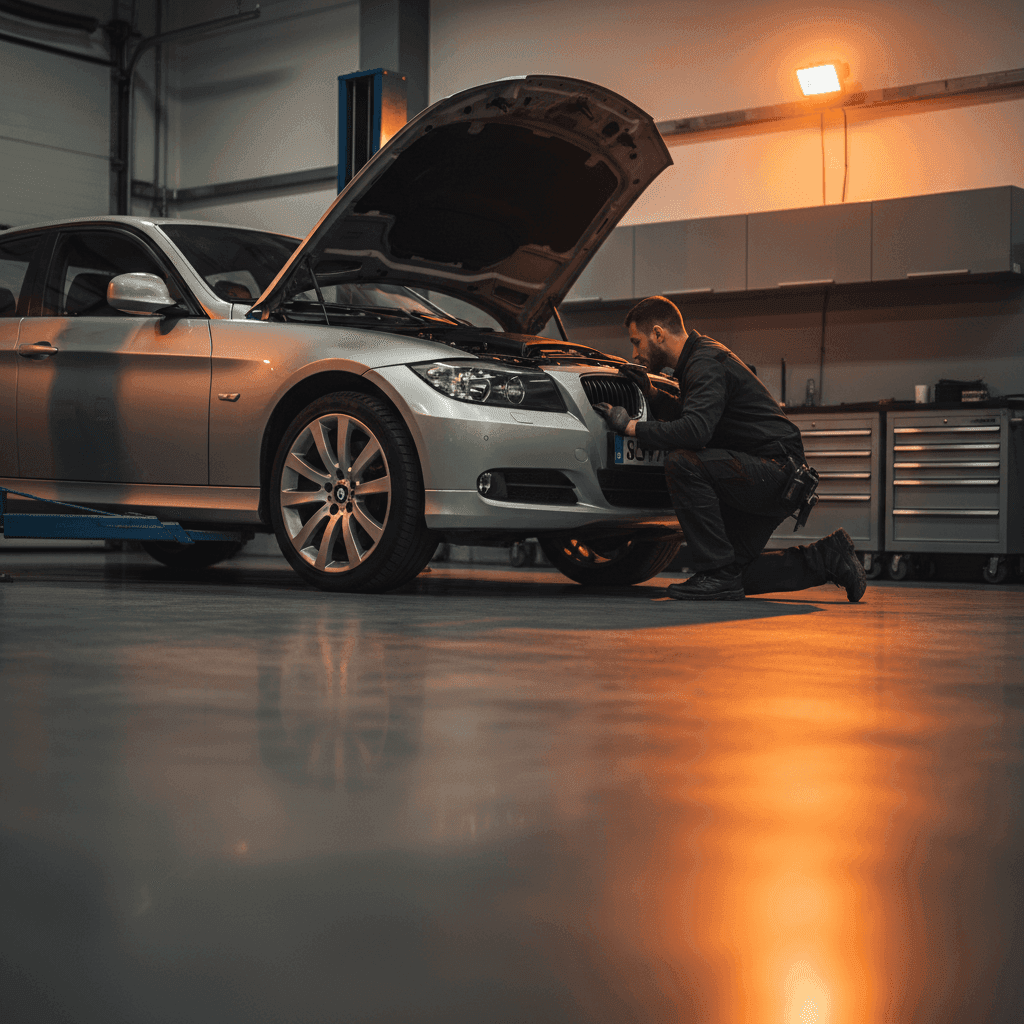
A used BMW E90 is still one of the most sought-after premium sedans in BiH, but price and looks do not tell the full story. The difference between a good example and a car that will cost you thousands of KM over the next two months lies in the engine and service history, not in the trim level. This guide covers what you really need to check before putting down a deposit.
This guide was put together by the Auto Gas Gaga workshop in Banja Luka, based on years of service experience with E90-series BMW engines.
Table of Contents
- Why the BMW E90 Still Attracts Buyers in BiH
- Generations and Body Styles: E90, E91, E92, E93 and the LCI Facelift 2008
- Engines: M47, N47, N46, N43, N52 and Which to Avoid
- N47 Timing Chain: The Biggest Risk When Buying
- What Else to Check at Inspection: Turbo, Injectors, Dual-Mass Flywheel, Cooling
- Real Maintenance Costs in BiH and Parts Availability
- Which Model Years and Engines Are the Smartest Choice
- Frequently Asked Questions
- Related Articles
Why the BMW E90 Still Attracts Buyers in BiH
The E90 is the first generation of the 3 Series to offer interior quality and driving dynamics close to more expensive BMW models, and today it is offered in the region at the price of an ordinary used compact. Rear-wheel drive, honest chassis tuning and quiet running make it an excellent everyday car, while the availability of used parts in Bosnia and Herzegovina is at a solid level. Precisely because there are so many on the market, the difference between an example that will serve for years and one that is facing a serious fault can be significant.
At the same time, many buyers choose the E90 because they see it as a premium car for the price of an ordinary used one, which is true only if you pick the right combination of engine, year and service history. Otherwise, the savings on purchase quickly disappear in the first major repair.
Generations and Body Styles: E90, E91, E92, E93 and the LCI Facelift 2008
The BMW 3 Series under the E90 designation was produced from December 2004 to October 2013, in four body styles: E90 sedan, E91 estate (Touring), E92 coupe and E93 convertible. The sedan is by far the most common in BiH, while the E91 Touring is the logical choice for those who need a boot for the family.
In September 2008 the LCI facelift arrived for the 2009 model year and onwards. LCI (Life Cycle Impulse) examples have redesigned front and rear bumpers, new headlights and tail lights, wider kidney grilles and a refreshed interior. For buyers in 2026, the LCI versions are preferable because they also bring improved electronics and updated engine variants. If you are looking at the economics, the sedan and estate are the most practical and the most numerous in local listings.
Engines: M47, N47, N46, N43, N52 and Which to Avoid
In the E90, the choice of engine matters more than the trim level. On the diesel side, the key split is between the older M47 engines (up to March 2007) and the newer N47 engines (from March 2007 to 2014). The older 320d with the M47 unit is known for mechanical robustness, simpler servicing and a much lower risk of timing chain failure. If you are looking for a reliable example with a manual gearbox and have the patience to wait for the right listing, the pre-facelift 320d M47 is the safest choice.
The N47 is the successor to the M47, produced from March 2007 to September 2014, when it was replaced by the B47. This engine brings smoother running and better fuel consumption, but also the infamous risk of timing chain wear that we cover in the next section.
For petrol engines, the picture is as follows:
- N46 (316i, 318i, 320i pre-facelift) comes closest to the ideal of a reliable E90 petrol, but it is slower and less powerful, so set realistic expectations.
- N43 (316i, 318i, 320i post-2007) with direct injection suffers from injector issues and rough idling, especially if the fuel quality is poor.
- N52 (325i, 330i) is a six-cylinder that sounds and drives beautifully, but has a tendency to leak coolant, blow thermostats and suffer from plastic cooling-system parts that crack with age.
For an average BiH driver who is looking for economy, a sensible order of preference is: 320d M47 pre-facelift, 320d N47 LCI with a documented chain service, 318i N46, and only then the petrol six-cylinders.
N47 Timing Chain: The Biggest Risk When Buying
The N47 timing chain is the topic that often causes an E90 with an N47 engine to sell for less than expected. The chain is positioned at the rear of the engine block, towards the bulkhead, which means that replacement requires removing the gearbox or the engine. This complicates the service, makes it more expensive and leaves the assembly more sensitive to insufficient lubrication, particularly on short trips and infrequent oil changes.
The worst-affected units were produced between 1 March 2007 and 5 January 2009. On those series BMW later changed the chain and tensioner design, but reported failures have continued to occur all the way up to 2015, which means that even the newest N47 units are not completely immune. It does not mean that every N47 engine is destined to fail, but it does mean that every N47 example has to be approached with full attention.
The failure is almost always announced by a characteristic rattling or metallic noise from the rear of the engine bay, most often during the first few seconds of a cold start. If the seller tries to start the car quickly before you get to it, that is a clear reason to sit down and start the engine from cold yourself.
According to Autodoc figures, a standard N47 timing chain replacement in the UK costs between 2,000 and 4,000 GBP, while a full rebuild after a catastrophic failure (bent valves, damaged pistons) goes above 8,000 GBP. In BiH the prices are lower, but still significant: mechanical parts can be sourced at reasonable cost, but the labour hours and the skill of a technician who knows this engine are the main cost. Realistically, regular preventive chain replacement is considerably cheaper than a rebuild after the chain snaps. You will find more on symptoms and intervals in our article on when a timing chain or timing belt replacement is needed.
What Else to Check at Inspection: Turbo, Injectors, Dual-Mass Flywheel, Cooling
The timing chain is the biggest risk, but not the only one. On 320d examples past roughly 200,000 km, signs of turbo wear are common, and user reports bring up failures considerably earlier, sometimes around 80,000 km. Watch for bluish smoke under hard acceleration, loss of power and whistling from the engine bay. We have described the detailed symptoms in our article on diesel injector symptoms and faults, which also covers part of the 320d problem area.
The dual-mass flywheel (DMF) is another point not to skip. On E90 manuals, especially on the 320d, the DMF takes a beating from harder use and short trips, and it can fail before 150,000 km. Rattling on start-up and shut-down, as well as idle vibrations, are the classic signs. You can read more about when the flywheel becomes a problem in our guide to the flywheel and fault symptoms.
On the cooling side, the petrol engines (especially the N52) are known for coolant leaks, thermostat failures and plastic parts that become brittle. At inspection, check the bottom of the radiator, the hose connections and the condition of the expansion tank. On the diesels, keep an eye on the EGR system: in 2018 BMW issued a recall covering around 1.6 million vehicles with N47 engines due to EGR cooler leaks that could cause the intake components to melt. If the car does not yet have the recall closed out on paper, that is a separate negotiation item.
In addition, a 2017 recall affected around 672,000 E90 examples from the 2006 to 2011 model years due to faulty wiring on the air-conditioning fan, so check whether that one has been handled as well. On all engines, a knocking noise at cold start lasting a few seconds often points to air in the hydraulic lifters or low oil level, which is a sign that the car has not been well maintained.
Finally, do not skip the awkward spots either: the plastic flaps in the intake manifold are a well-known weak point, and the automatic gearbox can be troublesome if it has not been serviced regularly. If you do not have an experienced mechanic friend, it is wise to take the car to a workshop that knows BMW before you sign anything. In our article on how to choose a car workshop in Banja Luka we covered what to expect from a serious service.
The E90 has been on European roads long enough that, on most examples, the question is not how many owners the car has had, but what kind. M-package variants are often driven aggressively, many have been repainted after accidents and resold as "imports from Germany", and the mileage on the dashboard is frequently not the real one. A serious workshop inspection will catch the physical clues, but the fastest way to pull up the paper trail is through carVertical. Using the VIN, it draws on international registers and typically shows mileage readings by date, recorded accidents and total losses, the list of countries where the car has been registered, the number of previous owners and theft indicators. Combining a pre-purchase inspection with a vehicle history check matters especially on this generation, because poorly disguised accident repairs and rolled-back mileage are model-specific risks on the E90. When you pay for the report, you can use the code GAGA to get 20% off.
Real Maintenance Costs in BiH and Parts Availability
The BMW E90 is not expensive for routine maintenance if you look at it through a minor service interval, but genuine parts and BMW-specific oils are more expensive than on the VW Group or Japanese models. The good news is that in BiH there is a supply of quality used parts and enough quality aftermarket manufacturers (Mahle, Lemforder, Bosch, Febi, Meyle) who cover the most important items without the overpriced BMW sticker prices.
Costs that tend to surprise new E90 owners are: brake disc and pad replacement (BMW vented axles and sensors cost more than average), automatic gearbox service on the ZF 6HP19, and occasional electronic glitches (sensors, modules, a battery that needs coding). The N47 timing chain replacement at independent workshops in the region remains the single biggest line item, which is why buying an E90 without a service history is an economically risky move.
For drivers planning to keep the car longer and covering a solid annual mileage, an E90 with a clear service history, regular oil (BMW Longlife-04 or equivalent) and a sorted cooling system can be very cost-effective. It is important to understand that this car does not forgive infrequent oil changes and cheap fuel.
Which Model Years and Engines Are the Smartest Choice
If you are looking for the most reliable combination for BiH conditions, aim for:
- 320d M47 pre-facelift (2005 to March 2007), manual gearbox. The mechanically simplest E90 variant, with no N47 trap, excellent fuel consumption, and chains and tensioners that have proven to be more reliable.
- 320d N47 LCI (2009 onwards) with a documented chain replacement or service history confirming that replacement has been avoided based on inspection. This is the compromise between a more modern car and an acceptable risk.
- 318i N46 LCI for the buyer who drives around town and is not chasing a sporty feel, with emphasis on a tidy, regularly serviced example.
Avoid: N47 series from the March 2007 to January 2009 period without a documented chain service, N43 petrols without injector service history, and any example where the seller cannot answer questions about oil, intervals and previous repairs. If the price is significantly below market, there is always a reason. If you plan to buy an E90 and are not sure about its condition, booking a pre-purchase inspection at a specialist workshop is the cheapest insurance policy you can pay for.
Frequently Asked Questions
Which engine is the most reliable in the BMW E90?
Mechanically, the most reliable E90 engine is the 2.0 diesel M47 from the pre-facelift period (up to March 2007), because it does not have the problematic timing chain of the N47 engine. Among the petrols, the N46 in 318i and 320i pre-facelift versions is the simplest to maintain. The newer N47 from the LCI facelift can be reliable, but only with a clear service history.
How do you spot an N47 with a timing chain problem?
The clearest symptom is a metallic rattling or clattering from the rear of the engine (towards the bulkhead) in the first few seconds after a cold start. The noise fades as the engine warms up, which misleads drivers. If the seller insists on starting the car before you arrive, that is a warning sign and a reason for an inspection at a BMW specialist.
Is the N47 chain always a problem, or only on certain model years?
The highest risk is carried by units produced between March 2007 and January 2009. BMW later changed the chain and tensioner design, but reported failures occurred right up to 2015. It cannot be said that every N47 is destined to fail, but each one needs to be approached with a service history check.
Which body style is the most practical, the E90 sedan or the E91 estate?
For most BiH buyers the E90 sedan is the most practical because it has the largest number of listings, the best parts supply and the lowest price. The E91 Touring is the logical choice if you need a boot for the family or sports gear, at the cost of a slightly heavier body and marginally higher fuel consumption. The E92 coupe and E93 convertible are first and foremost an emotional choice.
How much does BMW E90 servicing cost in BiH?
A routine minor service is not dramatically more expensive than for the VW Group, but genuine BMW parts and specific oils push the bill up. Aftermarket manufacturers such as Mahle, Bosch, Febi and Lemforder cover most items at reasonable prices. The single biggest cost is the preventive N47 timing chain replacement, which should be planned with a technician who knows this engine.
Is it advisable to buy a BMW E90 with an automatic gearbox?
The ZF 6HP19 automatic gearbox in the E90 is reliable if it has been regularly maintained, with oil and filter changes at around 80,000 to 100,000 km, even though BMW did not officially call for the change. Jerking, delayed shifts or rough gear changes are signs that the gearbox needs a service or diagnostics before purchase.
Related Articles
- When a timing chain or timing belt replacement is needed
- Diesel injectors: symptoms of failure and what to expect
- When the flywheel becomes a problem and how to recognise the symptoms
Do you drive a BMW E90 or are planning to buy one and are looking for a workshop that really knows this model? Auto Gas Gaga services the BMW E90 regularly - get in touch.