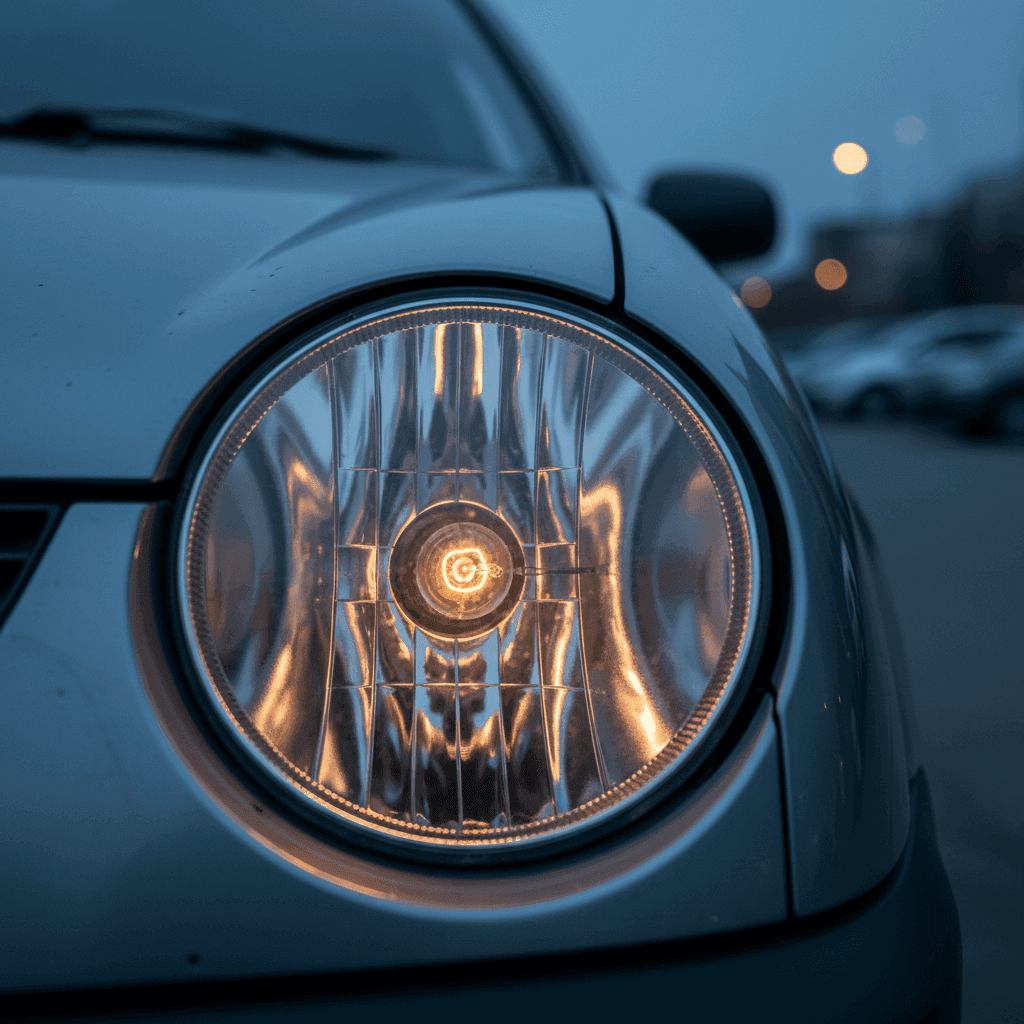
Almost every week someone asks us the same question: can I fit LED bulbs instead of halogen in my headlight and still pass the MOT? The short answer for LED bulbs in BiH 2026 is that it is technically possible, but only under narrow conditions and exclusively with type-approved products certified for that specific car model. In this article we explain what the law requires, what the MOT station looks at, and which two product lines are currently the only correct route.
This guide was put together by the Auto Gas Gaga workshop in Banja Luka, based on years of experience with the lighting equipment of European used vehicles and tracking the regulations on light source type approval.
Table of Contents
- Why LED in a Halogen Headlight Is a Legal and Technical Problem
- What the MOT Inspection in BiH Actually Checks
- ECE Regulations That Decide: R37, R112, R128
- The Only Legal Path: A Type-Approved Retrofit LED Bulb
- OSRAM Night Breaker LED and the ABG Procedure
- Philips Ultinon Pro6000: The Second Type-Approved Choice
- How to Check the Compatibility List
- The Reality on the Ground in BiH
- Alternatives If Your Car Is Not on the List
- Frequently Asked Questions
- Related Articles
Why LED in a Halogen Headlight Is a Legal and Technical Problem
A halogen reflector is designed around a single point in space, the focal point, where the filament of the halogen bulb sits. The geometry of the reflector, the shape of the lens, and the final beam are all tuned so that light leaves that focal point and falls on the road along a precisely defined curve.
When you drop an ordinary aftermarket LED into that housing, the diode is not at the same focal point. LED chips are flat, arranged along the sides of a carrier, and the actual source of light is spread over several millimetres that the halogen reflector has no way to focus. The result is that the beam no longer has a sharp cut-off line protecting the oncoming driver, and excess light escapes upwards and to the sides, dazzling other road users. From the legal side, replacement LED bulbs fitted into a halogen headlight are not regulation-compliant and the vehicle will not pass the MOT if it is carried out correctly, something that was already explained in detail in the region's specialist motoring press back in 2022.
A second layer of the problem is the type approval of the headlight itself. The manufacturer type-approved it as a complete unit, with a precisely specified light source under ECE regulation R37 (filament) or R128 (LED). If you cram an LED that was never intended for it into an R37-approved headlight, the R112 conformity of the whole assembly falls away, which means the headlight is no longer what the manufacturer declared at the vehicle's type approval.
What the MOT Inspection in BiH Actually Checks
At the front lighting assembly the MOT station checks several things. Visual condition of the headlight: not cracked, not foggy to the point of being unreadable, not subsequently opened and glued shut in a way that lets water in. Functional operation: low beam, high beam, indicator, parking and position lights. And third, most important for this topic, the beam check using a headlamp aimer (regloscope).
The regloscope projects the low beam onto an internal screen and the operator, by eye or by sensor, compares the edge of the beam with the prescribed cut-off line. With a sound halogen or factory type-approved LED headlight, that line is sharp and tilted at the defined angle. With a headlight into which a non-type-approved LED has been fitted, the edge is usually fuzzy, wavy, or raised too high. Stations that follow the rules will mark such a headlight as non-compliant.
Beyond the regloscope, the operator can simply look into the headlight bore. A bluish diode in a housing intended for a halogen bulb is visually so obvious that measurement is not even needed. An experienced inspector in that situation will ask for type approval documentation for the light source, and that is where most vehicles fitted with LEDs from a Chinese AliExpress box fail. The broader picture of the MOT is covered in a separate article on the MOT inspection in BiH 2026.
ECE Regulations That Decide: R37, R112, R128
The legal framework for bulbs in main headlights is not a local invention; these are ECE regulations that BiH adopts along with the rest of Europe. Three regulations decide the matter:
- ECE R37 governs filament bulbs, the classic halogen bases H1, H4, H7, H11 and so on. Every halogen on sale carries an E-mark under R37.
- ECE R128 governs LED light sources. Under this regulation, factory LED modules in new cars and approved retrofit LED bulbs that have passed the test cycle are type-approved.
- ECE R112 governs the reflector itself and type-approves the headlight as a whole, with a specific light source inside. R112 is the layer that falls the moment you put a bulb into the headlight that is not what the manufacturer specified.
By fitting a non-type-approved LED into a headlight type-approved for halogen under R37, the vehicle is left without valid R112 conformity for that assembly, and therefore without compliant front lighting in the sense of the local regulation on technical requirements. This was already discussed in the European Parliament back in 2021, with calls to regulate LED retrofits separately, while the R37/R112/R128 foundation stays the same.
The Only Legal Path: A Type-Approved Retrofit LED Bulb
There is a narrow window in which an LED replacement for a halogen bulb is legal. That is a type-approved retrofit LED bulb, certified for a specific vehicle model and a specific base, fitted into a headlight that the manufacturer originally type-approved for halogen under R37. The principle:
- The bulb manufacturer (OSRAM or Philips today) develops an LED with the same external dimensions, position of the light source and emission characteristic as the halogen it replaces. Fitted into the type-approved halogen reflector of a specific vehicle, it produces a beam that meets the prescribed curve.
- The bulb is tested in an accredited laboratory. In Germany, TÜV SÜD developed the first test procedure for type approval of LED retrofit bulbs in 2020 and issued the first general type approval in September of the same year.
- A general operating permit is obtained (ABG, Allgemeine Betriebserlaubnis), but not universally - it is tied to a list of vehicles whose headlight type approval number matches the one the bulb was tested for.
- After fitting, the owner must go to an authorised inspection station to have the individual approval entered into the vehicle's documents. Without that entry, the MOT station is fully entitled not to recognise the installation.
Everything else is in a grey zone or outright non-compliant. In the EU, the UK and Australia, aftermarket LED replacements in a halogen housing typically fail roadworthiness tests unless they carry an ECE/E-mark for that specific vehicle, which remains a very limited option even in 2026. The fact that someone from the neighbourhood drives with LEDs and passed the MOT does not mean you are safe, it just means the inspector let it slide.
OSRAM Night Breaker LED and the ABG Procedure
OSRAM is currently the most widespread option on the Western European market. The Night Breaker LED line is available for halogen bases H1, H4, H7, H8, H10, H11 (SMART ECE), H16, HB4 and W5W. The H7 and H4 versions carry an ABG permit, but only for vehicles whose headlight type approval number matches the one on the official OSRAM compatibility list, which OSRAM publishes and updates separately for individual markets, including one flagged for BiH.
In practice the procedure looks like this. You open the OSRAM list and look up your model, year of manufacture and headlight type. The list is not universal - a 2008 Golf 6 is not the same case as a 2012 Golf 6 because of changes in the optics. If the car is on the list, you buy the bulbs in their original packaging, which contains the ABG paper with a serial number. You fit them (some models need a CAN-bus adapter to avoid a "bulb failure" warning light), and then with the ABG paper and the vehicle registration document you go to an authorised inspection station to have the installation recorded. Without that entry, the paper from the box carries no weight at the MOT station. That is the part people overlook most often.
OSRAM Night Breaker LED H7 Vehicle List and the H4 Difference
The H7 base is by far the most common in Europe and the OSRAM list for H7 is significantly longer than the list for H4. H4 is a dual-filament source, one filament for low beam and one for high beam, which complicates an LED retrofit because both geometries have to be simulated from the same bulb. For that reason the number of models on the H4 list is narrower and typically refers to somewhat newer vehicle generations. If you have an older car with H4 headlights, search the list by VIN or headlight marking before you pay.
Philips Ultinon Pro6000: The Second Type-Approved Choice
The other manufacturer with a proper type approval is Philips. The Ultinon Pro6000 H7 LED line, according to its declaration, gives significantly more light than the standard halogen, has KBA approval for selected models from the compatibility list, and is announcing an expansion of the list for 2026.
The substance is the same as with OSRAM: the list decides, not the marketing on the packaging. Philips maintains a public PDF document with the compatibility list, the last major update being in November 2025. Before buying, open that PDF, look up your model and year and check whether your headlight type is flagged for H7 Boost LED. The procedure after that is identical to OSRAM. Some choose Philips when OSRAM does not cover their model, or vice versa. There is no single winner - there are two product lines and two lists which do not fully overlap.
How to Check the Compatibility List
There is a simple sequence we recommend to every driver interested in LEDs:
- Find the type approval number of the front headlight. It is moulded into the plastic of the headlight itself, in the form of a mark like "E1 12345" or "E4 56789". The letter E with a number indicates the country that issued the type approval, the number is the type approval itself. That number is what the OSRAM and Philips lists ask for.
- Open the OSRAM compatibility list. OSRAM has an official page for our market. The list filters by make, model, year and base. The most reliable entry point is via the VIN number or the headlight marking.
- If OSRAM does not cover you, open the Philips Ultinon Pro6000 list. This is the PDF document that Philips updates several times a year.
- Phone the authorised inspection station in your area. Practice between stations can vary, especially between entities. If the station that registers your car does not deal with LED retrofit entries, all the previous work falls apart.
If all this is too complicated to sort out yourself, drop us a line or stop by the workshop and we will check the list for your specific car together.
The Reality on the Ground in BiH
The most common situation is a driver who has bought "premium" LEDs on some internet site, fitted them himself and is now heading to the MOT. The bulb is neither OSRAM Night Breaker LED nor Philips Ultinon Pro6000, but some brand no one has heard of, with a questionable ABG list. There is no type approval entry to cover it, and the only honest recommendation is to put the halogens back before the car even leaves the yard. The second common situation is a driver who has genuinely type-approved OSRAM or Philips bulbs, but did not know about the requirement to enter them in the documents, and so spends a year driving with economic exposure if inspection stops him. The third is a driver whose car is simply not on either list, usually an older car like an Astra G or Golf 4. There is no legal route via ABG there, only replacement of the entire headlight with a factory LED assembly if the manufacturer offers one at all.
An experienced seller can hide all of this from a used car buyer. Wound-back mileage, a headlight converted from LED back to halogen before sale so the car would pass the MOT, welds covered with paint. You catch some of it on a pre-purchase inspection, but the actual history of the car is most easily verified through carVertical. Using the VIN, it pulls documented history from international registers: mileage by year, recorded accidents, number of previous owners, and indicators of theft or total loss. We consider this a mandatory layer of defence before buying a used car. When paying for the report you can use the code GAGA for a 20% discount.
Alternatives If Your Car Is Not on the List
If you check both lists and cannot find your car anywhere, that does not mean you are condemned to a non-compliant beam. There are several legal routes.
A better halogen bulb. Uprated halogen lines, for instance the Osram Night Breaker 200 or Philips RacingVision GT200, stay within R37 and do not touch the headlight type approval. They give noticeably whiter and more penetrating light than the factory halogen, their service life is shorter (around 1 to 2 years of intensive use), but they never fail the MOT. The cheapest route with no paperwork.
Headlight restoration. Older headlights are more often foggy and have lost their reflective coating than they have actually lost the light source. Polishing the lens, cleaning the reflector and an uprated halogen bring the beam back within the limits the manufacturer intended.
Complete headlight replacement with a factory LED assembly. Some manufacturers offer an LED headlight as an option for the same vehicle generation. You buy an original LED headlight, which already carries its own R112 type approval, and install it with the matching module. A true LED, with a compliant beam, no problems at the MOT. The price depends on the specific model and parts availability, so get in touch for a quote.
Patient waiting for the list to expand. Both OSRAM and Philips expand the vehicle lists each year.
What is absolutely not an alternative is buying "type-approved" LEDs from an unverified source and driving with a dazzling beam towards colleagues in the oncoming lane. Before any change of lighting, it is also useful to read through the most common reasons cars fail the MOT.
Frequently Asked Questions
Do LED bulbs in a halogen headlight fail the MOT inspection in BiH?
Yes, they fail, if the station does its job properly. The beam of a non-type-approved LED in a halogen reflector has no defined cut-off line and the regloscope picks that up. The only exception is a type-approved retrofit LED (OSRAM Night Breaker LED or Philips Ultinon Pro6000) for a model that appears on the manufacturer's official list and with the installation entered into the vehicle's documents.
What does an ABG certificate for LED bulbs mean?
ABG is the German general operating permit (Allgemeine Betriebserlaubnis). For LED retrofit bulbs the ABG is not universal - it is issued in connection with specific vehicle models from the compatibility list. With the ABG paper from the box, the owner must go to an authorised inspection station and have the installation recorded in the documents. Without that entry, the paper on its own is not enough.
How much does a type-approved H7 LED bulb cost in BiH?
The price depends on the specific offer and the base. In addition to the bulb itself, you also need to budget for the cost of the type approval entry at an authorised inspection station. For the current price and installation for your specific case, get in touch.
What is the difference between OSRAM Night Breaker LED and Philips Ultinon Pro6000?
The principle is similar: both manufacturers make type-approved retrofit LED bulbs with an ABG permit tied to a vehicle list. They differ in the bases they cover, the vehicle models on the lists and the technical design (chip, optics, CAN-bus). In practice, the driver checks both lists and picks the one that covers them.
Can I fit an LED W5W (position/parking) bulb without type approval?
The OSRAM Night Breaker LED W5W does not require a compatibility list and is type-approved for all 12V vehicles. Position, parking and number plate lights are a simpler case than the main headlights because they do not affect the beam falling on the road. For reliability we still choose official manufacturers, not aftermarket "universal" LEDs.
What if I have already fitted non-type-approved LEDs and I am heading to the MOT?
The most honest route is to refit halogen bulbs before going to the inspection. We do this regularly for clients - it takes a few minutes per bulb. If your halogen has already failed, we will fit a new uprated halogen and the car will pass the regloscope without any problem. Removing the LED is not an admission of guilt, just a calm way of sorting things out.