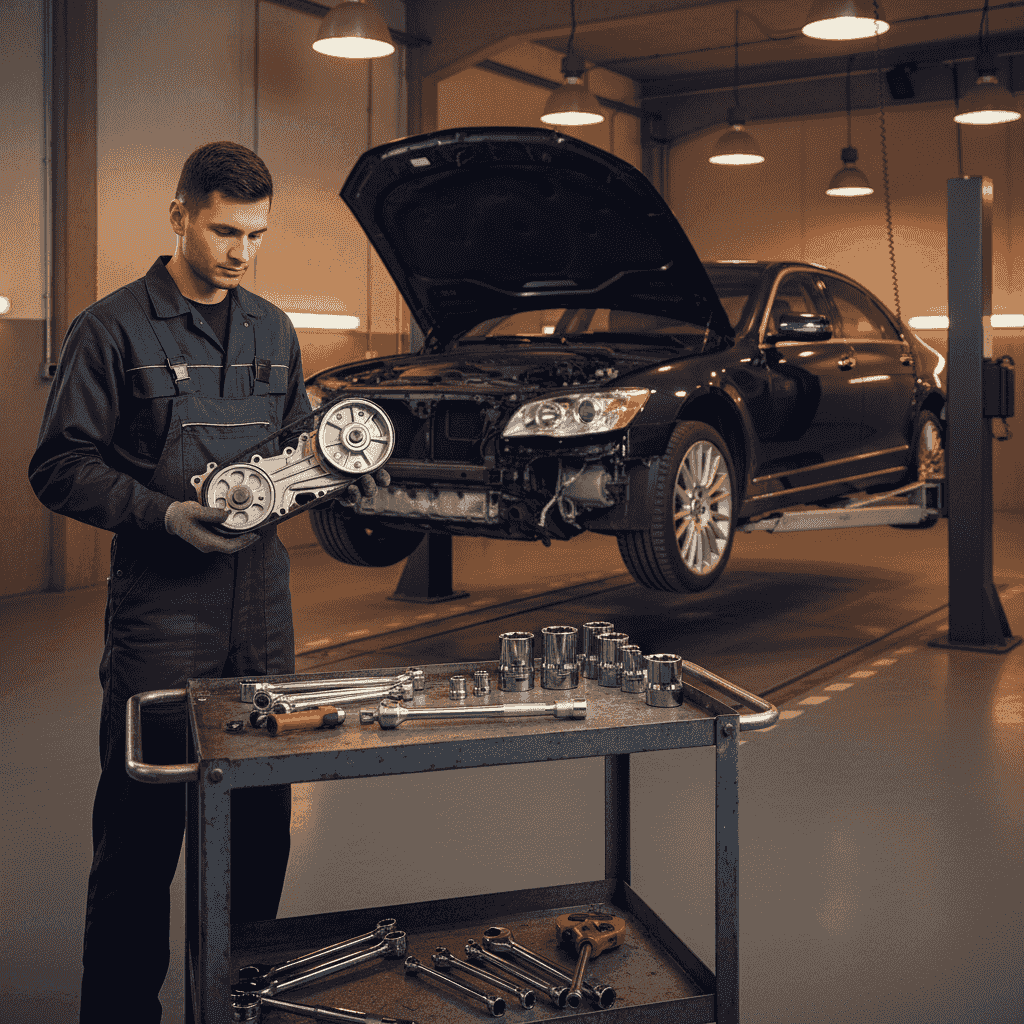
The major service at 100,000 km is not a marketing label but a concrete list of items the engine and the rest of the car need to safely cover the next hundred thousand. Used-car owners in BiH usually only show up after something has already broken, treating that first milestone as "I have time" until the bill for bent valves arrives. This guide walks through everything that gets replaced, what differs by drivetrain, and how to vet a car that has crossed the mark without a clean service history.
This guide was put together by the Auto Gas Gaga workshop in Banja Luka, based on the regular major services we perform on used VAG, PSA, Ford and Opel engines ranging from 90,000 to 250,000 km.
Table of Contents
- What a major service at 100,000 km actually means
- Fluids that must be replaced
- Timing belt or chain - when, what goes in the kit
- Filters and spark plugs or glow plugs
- If the car crossed 100,000 km without a complete service
- Differences by drivetrain - diesel, petrol, petrol plus LPG
- DSG and automatic gearboxes - a special rule
- What pushes up the major service bill in BiH
- Frequently Asked Questions
- Related Articles
What a major service at 100,000 km actually means
A minor service is an oil and oil-filter change, maybe one more filter. The major service at 100,000 km is the next tier. It is the moment when you deal with components that are not replaced every year but are as worn out as the engine itself.
Concretely, the standard package for the major service at this mileage includes: engine oil with filter, air filter, fuel filter, cabin (pollen) filter, brake fluid, coolant, a timing belt kit with water pump (if the car has a belt), spark plugs on petrol or glow-plug check on diesel, plus an inspection of brakes, suspension and the cooling system. That is the core. Everything else is built on top of that skeleton depending on the state of the specific car.
The reason all of it is grouped under a single appointment is practical. Once you have already opened up the front of the engine to remove the timing belt, it is silly not to also replace the water pump and tensioners, because in a year you would be paying for the same labour again. The major service is not a list of separate jobs but a package that minimises how many times the engine has to be taken apart.
The service typically takes between four and eight working hours in the workshop, depending on the engine and how many parts are replaced in the same pass. The car stays for the whole day, not a few minutes.
Fluids that must be replaced
Fluids are the quietest item on the list. You don't hear them, you don't see them while everything is fine, yet as they age they lose their protective properties and silently kill the components around them.
Engine oil with filter. The standard interval on modern engines is 10,000 to 15,000 km, or once a year, whichever comes first. If you do short city trips, the oil collects moisture and fuel and you are better off changing at 8,000 to 10,000 km. Experienced mechanics change oil more often than the service book demands, especially on used cars that have spent half their life without proper servicing. Bad oil will not destroy the engine immediately, but it shortens the life of timing-chain components, hydraulic valve lifters and the turbo.
Coolant. Usually replaced at 60,000 km or every 4 to 5 years, depending on the specification (G11, G12, G12++, G13). At 100,000 km it is almost certainly already spent, and corrosion in the cooling system is something nobody notices until the radiator starts leaking. Since the cooling system is drained anyway when a full timing-belt kit is fitted because of the water pump, this is the moment to refill with the correct specification.
Brake fluid. The most often forgotten, the least expensive, and potentially the most dangerous. DOT3 and DOT4 fluids are hygroscopic, absorbing moisture from the air through hoses and the reservoir, so water builds up over the years. Even 2 percent water content drops the boiling point of DOT4 fluid by around 45 degrees Celsius. On long descents, when the brakes heat up, that water can boil and the brake cylinder loses pressure. That is why brake fluid is replaced every two years regardless of mileage, and 100,000 km is an absolute upper limit if it has not been touched in the previous life of the car.
Gearbox fluid (manual and automatic gearbox). A manual gearbox in practice asks for a fluid change every 80,000 to 100,000 km. That is the interval we treat as common sense in the workshop, even if the manufacturer sometimes labels it as "lifetime fill". With automatic and DSG gearboxes the rule is different and stricter, more on that below.
Timing belt or chain - when, what goes in the kit
This is the largest single item in a major service and the reason most engines have everything else grouped exactly around 100,000 km.
Timing-belt interval on popular BiH engines
Manufacturers prescribe timing-belt replacement most commonly between 90,000 and 150,000 km, while newer models go up to 200,000 km. For example, a VW Golf 5 with the 1.9 TDI engine (model year 2003) calls for replacement at 120,000 km, a Ford Focus 1.6 TDCi (2011) at 150,000 km, and a Peugeot 308 1.6 HDi (2008) goes up to 180,000 km. Still, those numbers assume the oil and conditions under which the car covered its first life. In BiH, with summer heat, cold winter starts and a lot of city driving, the sensible recommendation is to work to the lower end of the manufacturer interval, not the upper.
What goes in a timing-belt kit
Together with the timing belt, the BiH standard is to also replace the auxiliary (ribbed) belt, water pump, tensioners and idlers as required, plus drain and refill the coolant since the cooling system is opened anyway. The alternator pulley is inspected and replaced if it shows play or cracking. The reason all of it goes in together is straightforward. You pay for the labour of splitting open the front of the engine once. If the water pump fails a year later, the car goes back on the lift and the bill is almost the same as if it were brand new work.
Consequences of skipping the belt. On almost all modern engines the belt holds the precise alignment of the crankshaft and camshaft. If the belt snaps or skips a tooth on an interference engine (which is what nearly every modern diesel and petrol engine is), the pistons hit the valves, the valves bend, and the cylinder head goes for repair or replacement. The cost of a destroyed engine many times exceeds the cost of preventive belt replacement.
Chain instead of belt. Some engines (many BMWs, some Mercedes, part of the TSI range, Mazda Skyactiv) use a timing chain. A chain is in theory "lifetime", but in practice it stretches and after a certain mileage the tensioner and guides need to be inspected. Symptoms of a stretched chain: rattling on a cold start, uneven idle, eventually a timing-correlation fault. If you drive a chain-driven car, at 100,000 km you do not have a timing-belt line item, but a diagnostic check of the chain and tensioners belongs on the list instead.
Filters and spark plugs or glow plugs
All filters share one job, keeping dirt away from sensitive components. When they clog, the dirt goes inside or the engine starts losing capability.
The air filter is usually replaced every 30,000 to 60,000 km, so at 100,000 km a new one always goes on. A clogged filter restricts airflow and the engine noticeably loses power, especially on turbocharged engines. On a car driven on dusty BiH roads in summer, the upper bound is optimistic and the lower bound is realistic.
The fuel filter is critical on diesels because it protects the most sensitive and most expensive parts of the system, the high-pressure pump and the injectors. On a common-rail diesel the fuel filter is replaced every 30,000 to 60,000 km. At 100,000 km it should have been replaced long ago, and if there is no record in the service history it is replaced as a matter of course, because the pump and injectors cost many times more than the filter.
Cabin (pollen) filter. It does not affect the engine, but it does affect the air conditioning, the heating and the smell inside the car. It is replaced once a year, at the latest every 15,000 to 20,000 km. Used cars often arrive with cabin filters that have turned into a damp layer of dust and organic matter, which is why on some cars you get a stuffy, mildewy smell as soon as you switch the air conditioning on.
Spark plugs (petrol). Standard plugs last up to 30,000 km, iridium and platinum plugs up to 60,000 to 100,000 km. A car with worn plugs jerks, cold-starts poorly, uses more fuel and can damage the catalytic converter. At 100,000 km new plugs go in to the exact manufacturer specification. There is no improvising with "universal" replacements here.
Glow plugs (diesel). Glow plugs on a diesel are not replaced on an interval but on condition. At 100,000 km, especially if the car cold-starts with difficulty, a diagnostic check of the glow plugs and their relay is a mandatory item.
If the car crossed 100,000 km without a complete service
Most used cars arriving in BiH do not come with a complete service history. The seller says "everything has been done", the service book is empty, and you are looking at a car with 140,000 km and no proof of what was done when. This is the order we use in the workshop for those cases.
First, we pull the entire history of the car by VIN. An experienced seller can hide a lot - mileage rolled back by tens of thousands of km, a write-off respray sold as "import from Germany", welds hidden under paint. You catch part of that in a pre-purchase inspection, but the documented past of the car is most easily verified through carVertical. Using the VIN, it pulls the full history from international registers: real odometer readings by date, recorded accidents, number of previous owners and indicators of theft or write-off. We treat this as a mandatory layer of verification before any serious service on an unfamiliar used car, because if it turns out the car had its mileage tampered with, you are not at 100,000 km but at 220,000 km, and the replacement list looks different. When paying for the report you can use code GAGA for a 20% discount.
Second, we run a full diagnostic and a physical inspection on the lift. We check the timing belt (if it is visible through an inspection hole, we look at the condition and the manufacturing date stamped on the belt itself), the level and colour of every fluid, filter condition, cylinder compression, brakes and suspension. The goal is to answer one question: where is the car actually in its lifecycle, not where the odometer says it is.
Third, we build a priority list. If the budget is tight, what comes first is anything that can leave you on the side of the road or destroy the engine: timing belt (or chain diagnostics), brake fluid, engine oil, fuel filter on a diesel. The second round is coolant, cabin and air filters, spark plugs. The third round is cosmetics and comfort.
This procedure matters because a "100k major service" on a car possibly already crossing that mark for the second or third time is not the same job as on a factory-fresh car. Condition, not just the odometer, dictates what gets replaced.
Differences by drivetrain - diesel, petrol, petrol plus LPG
All engines need the same fluids and the same timing belt if they have one, but every drivetrain has its own specific items.
Diesel engines (TDI, HDi, CDi, CRDi). The principle is similar: common-rail diesel with a high-pressure pump, injectors, EGR valve and, on newer models, a DPF filter. Still, the execution, software, oil, service intervals and typical failures differ from one manufacturer to another. Specific items at 100,000 km on a diesel are: fuel filter (critical), EGR valve check (clogs up with sooty particles), DPF check if the car does a lot of city driving (it may be near regeneration or near replacement), injector inspection (return-line leaks are a common problem), turbo check. Diesels are more sensitive to inferior oil, so on high-mileage cars we go to shorter oil intervals.
Petrol engines (FSI, TSI, MPI, naturally aspirated). A classic petrol engine at 100,000 km is relatively forgiving when it comes to servicing. Specific items: new spark plugs to factory specification, ignition-coil check, lambda-sensor inspection (the upper sensor typically lasts 80,000 to 130,000 km, the lower one longer), throttle-body check (often gets dirty from the PCV system), inspection of direct-injection engines (TSI, TFSI, GDI) for carbon build-up on the intake valves, since with direct injection the valves are not washed by fuel as on indirect injection.
Petrol plus LPG. A car running on LPG is the standard in BiH, not the exception. The major service then has an extra layer. On top of everything that goes on a pure petrol engine, the LPG-system service is added: liquid-phase LPG filter, vapour-phase filter, regulator and vaporiser check, dosing-valve calibration check (on liquid systems), inspection of seals and hoses. The LPG system has its own interval that does not always line up with the engine mileage, but at 100,000 km some intervention is almost always needed. Spark plugs on an LPG car are exposed to higher thermal load and are replaced more frequently than the manufacturer specifies for a pure petrol engine. Auto Gas Gaga handles everything from installation to servicing, certification, injector cleaning and full system integrity checks, which means the major engine service and the LPG-system service can be done in the same visit.
DSG and automatic gearboxes - a special rule
This is the topic where most mistakes are made and most money is wasted. The myth of "lifetime fluid" in an automatic and DSG gearbox comes from factory marketing, not technical reality. "Lifetime fluid" means one thing: the gearbox will last the warranty period, what happens after that is your problem.
DSG dry (DQ200, 7-speed). Mechatronic fluid is replaced in the 60,000 to 90,000 km range, along with the mechatronic filter. Most owners think there is no need because the clutches are dry, which is a mistake. The fluid in the mechatronic unit works under pressure, carries debris and starts to break down the electro-hydraulics. The main cause of mechatronic failure on the DQ200 is precisely skipping this change. A more detailed walk-through of automatic-gearbox types and intervals is on our advice page about when DSG, automatic and CVT gearbox oil should be serviced.
DSG wet (DQ250, DQ381, DQ500). The wet DSG has fluid that cools and lubricates the clutches. The standard replacement interval is around 60,000 km, shorter than the dry one.
Classic automatic (ZF 6HP, 8HP, Aisin, 7G-Tronic). The experienced recommendation is an ATF and filter change every 80,000 km, despite the manufacturers' "lifetime fluid" claims. A used car with 150,000 km that has never had an ATF change is almost certainly on the verge of its first serious failure.
CVT gearbox. The strictest regime, every 50,000 km. The CVT is the most sensitive of all variants to fluid condition and a late change is a near-certain ticket to a full gearbox replacement. For symptoms of a stretched or damaged timing drive and how the diagnostics are run, our advice page gives a practical overview in the article when timing chain or belt replacement is needed.
If your car is at 100,000 km and the previous owner never touched the gearbox fluid, that is not an item you can put off until the next major service. It goes in the first pass.
What pushes up the major service bill in BiH
Concrete amounts for a major service vary widely by make, engine and what turns up on the inspection. In BiH in 2026 the range is broad, and it is more honest to talk about what pushes the price up and down than to invent precise numbers.
A standard 1.6 or 1.9 TDI with a timing-belt kit, oil, filters, brake fluid, coolant - that is one logical package. A premium European engine (BMW, Mercedes, Audi 3.0 V6) is another logical package, with a higher tier of parts and labour. A service on a chain-driven engine takes the biggest item out of the equation but adds diagnostics. An LPG car adds a layer of LPG service.
Things that push the bill up: using OEM parts instead of high-quality aftermarket alternatives (sometimes the difference is double), a faulty part discovered only once things are taken apart (a bent timing-belt guide, a wobbly crankshaft bearing), a replacement that was not planned but makes sense in the same pass (camshaft seals, oil pan). Things that sit at the lower end of the range: a standard engine with no complications, quality but not premium parts, a complete history so nothing is replaced preventively without need.
The price depends on the specific car and the specific findings of the inspection. Get in touch for a quote with the VIN and service history and you will get a realistic range before you bring the car in, instead of an open-ended bill. If you are about to buy, book a pre-purchase inspection so you get the real picture of the condition before you put a deposit down.
Frequently Asked Questions
Can I delay a major service from 100,000 km to 130,000 km?
Technically yes, in practice it depends on which part you are delaying. Oil, filters and brake fluid you do not delay because they are cheap and the consequences of delay are expensive. Delaying the timing belt is at your own risk, because the moment it snaps or skips, valves bend, and a cylinder-head repair vastly exceeds the cost of belt replacement. If you decide on a partial service, at the very least do oil with filter, brake fluid and a check of the belt or chain.
Is it mandatory to replace the water pump when replacing the timing belt?
In practice, yes. The water pump usually sits behind the front cover of the engine, the same place as the timing belt. The labour to replace it is almost identical to the labour to replace the belt. If the pump leaks or its bearing starts whining a year or two later, you are back to the same headache and the same bill. That is why a standard timing-belt kit in BiH includes the water pump.
What is the difference between a major service at an authorised dealer and an independent workshop?
An authorised dealer typically uses OEM parts and charges labour to its own price list, which is higher. An independent workshop can use either OEM or quality aftermarket parts (Bosch, Continental, INA, Sachs, Febi) and has more flexible labour rates. For an out-of-warranty used car, a quality aftermarket kit with a known-brand label is usually the optimal balance of quality and price. The main difference is not in the quality of the work but in the fact that the lack of OEM branding does not count as a flaw on a car long out of factory warranty.
Does a chain-driven car not need a major service at 100,000 km?
It does, just without the timing belt. All other items (fluids, filters, spark plugs or glow plugs, cabin filter) still apply. On top of that, on chain-driven engines at 100,000 km we run a diagnostic check of the chain, tensioners and guides, because those are parts that nominally are not replaced but in practice tend to show wear right around this mileage.
How long does a major service take in the workshop?
On average four to eight working hours, depending on the engine and the scope of work. If the timing belt and kit, coolant, oil with all filters and an inspection of everything else are done in the same pass, that is a full working day in the workshop. You drop the car off in the morning and pick it up in the afternoon or the next day.
How do I know whether my car has a timing belt or chain?
The safest way is to check the service book, the manufacturer page or ask the mechanic who has the car on the lift. As a rule: older TDI engines from the VAG group (BLS, BKC, BXE, BLB, CBAB) have a belt. Most BMW engines have a chain. Mercedes is mixed, depending on the year and engine. PSA HDi engines have a belt, some even running in an oil bath. The most precise answer comes from a VIN lookup.