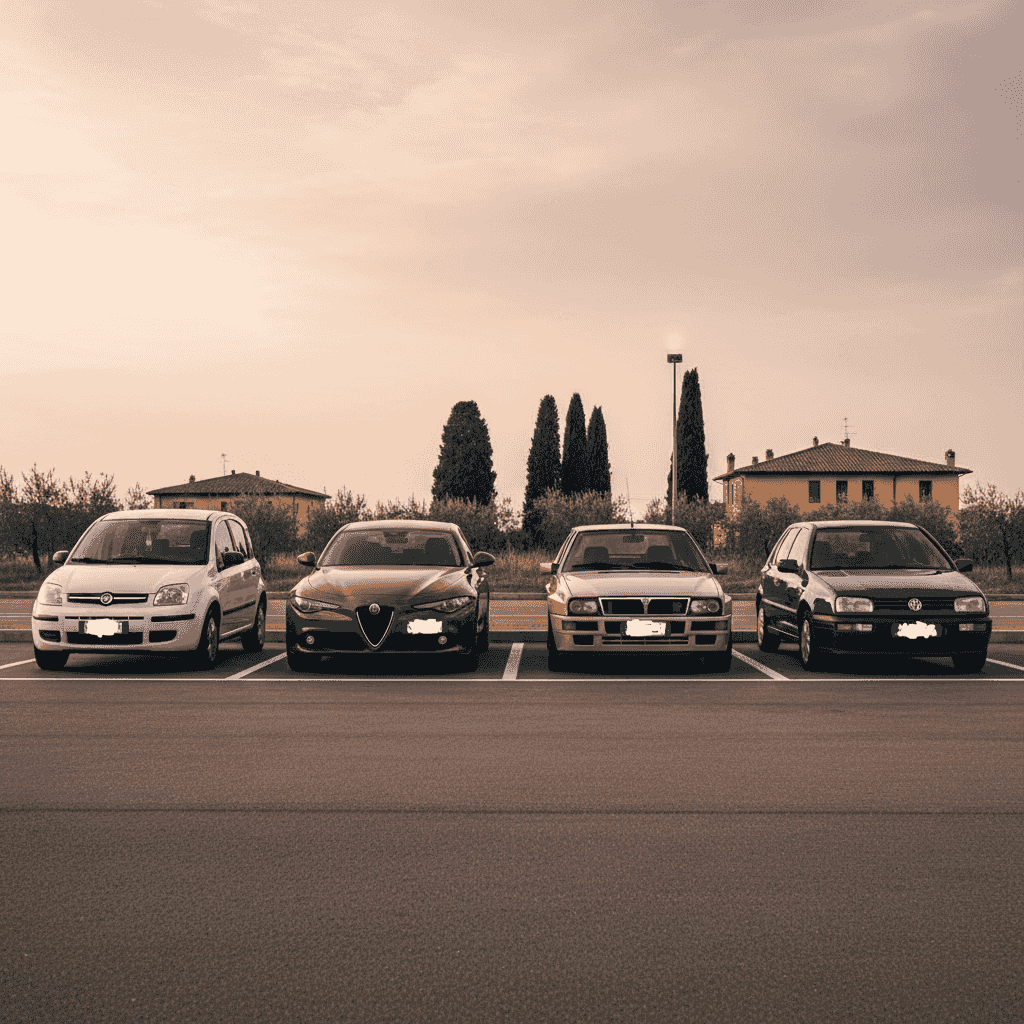
Importing a used car from Italy to BiH in 2026 is no more complicated or expensive than importing from Germany, yet it offers a market with drastically fewer hidden damages. According to new figures from a domestic automotive outlet, 84% of used vehicles entering BiH from Germany have a recorded incident, while for Italian vehicles that share is only 17.2%. In this guide we go step by step: where to buy, what paperwork the seller must hand over, how the car is deregistered from the Italian registry (Radiazione per Esportazione), exactly what you pay at BiH customs, the deadlines for homologation, and the most common pitfalls we see in practice.
This guide was prepared by the Auto Gas Gaga workshop in Banja Luka, based on official UINO BiH data, Italian vehicle export sources, and many years of experience with pre-purchase inspections of imported used cars.
Table of Contents
- Why Consider Italy Instead of Germany
- The Numbers: Damage, Mileage, and History by Country of Origin
- Where to Buy in Italy
- Italian Documents the Seller Must Provide
- Radiazione per Esportazione: A Mandatory Step Before Export
- Targhe EE and Foglio di Via: Temporary Plates for the Drive Home
- What You Pay in BiH: Customs, Excise, and VAT
- Homologation and Technical Inspection in BiH: 6-Day Deadline
- Realistic Cost of Travel and Transport from Italy
- Common Pitfalls: From ZTL Fines to Hidden History
- Checking the History of an Italian Vehicle Before Buying
- Frequently Asked Questions
- Related Articles
Why Consider Italy Instead of Germany
Germany has been the first choice for BiH buyers for decades, and we covered the German procedure itself in a separate guide to importing a used car from Germany to BiH. The reason is obvious: huge supply, a dense network of dealerships, tidier service history, and a culture of regular technical inspection. The problem is that dealers and middlemen have done the same calculation. The German market is now flooded with cars that no local German buyer wants anymore. Lightly or heavily damaged examples are bought cheaply at auctions (Copart, IAAI via the Netherlands, local quasi-auctions run by insurance companies), patched up provisionally, and resold to Eastern Europe and the Balkans.
Italy is a different story. The market is large, supply is broad, but the export logic is not aimed eastward. Italians resell used vehicles internally, the number of damaged units in the system is significantly lower, and the maintenance culture, especially in the north (Lombardy, Emilia-Romagna, Veneto, Piedmont), is better than the average buyer expects. That does not mean Italy offers flawless cars. It means the numbers are in favour of a buyer who knows where to look.
The second important difference is the structure of supply. Italy offers far more petrol cars and far more small city vehicles (Fiat 500, Panda, Punto, Lancia Ypsilon, Toyota Yaris) than Germany. If you are looking for a second household car, a city car for your wife or daughter, or a smaller vehicle up to around seven or eight thousand KM, the Italian market often offers a better price-to-condition ratio than the German one.
The Numbers: Damage, Mileage, and History by Country of Origin
The figure that drew the most comments here in 2026 comes from an analysis of vehicles imported to BiH. Of used cars that went through a history check, fully 84% of vehicles imported from Germany had at least one recorded incident. For Italy that number is 17.2%, one of the lowest in Europe, on par with Slovenia (20.5%). The source cited in the automobili.ba article from May 2026 draws on the regional database of vehicle history checks.
Another important figure: in 2025, according to research covering used cars verified through international VIN registries in BiH, 54.7% of all imported units had a damage history. In other words, more than half of everything entering BiH from abroad today carries some trace: a minor or major accident, frame work, rolled-back odometer, or a technical claim. Italy does not erase that risk, but it proportionally reduces it from "eight in ten" to "fewer than two in ten".
Mileage from Italy is usually somewhat higher per vehicle than from Germany. Italians keep a car longer before passing it on. That sounds like a drawback, but in practice it often means gentler maintenance done at the right time and fewer "trophy" registrations on motorways. Italian motorways are tolled, which discourages the typical routine of a German driver who drives 80 km one way every day on the Autobahn and racks up 40-50 thousand km a year. The typical Italian profile is 12-18 thousand km per year, predominantly urban and regional driving.
Where to Buy in Italy
Three main routes for finding a vehicle:
Subito.it is the Italian equivalent of OLX. Huge volume of listings, a mix of private sellers and dealers, weaker quality of descriptions. This is where the cheapest examples turn up, but also the most pitfalls. Use Subito as a first layer of market scanning, not as the place for a final purchase without in-person contact.
AutoScout24.it and Automobile.it have a higher share of dealerships and registered dealers. Prices are slightly higher, but the paperwork is usually clean and you can arrange part of the purchase by email and phone. AutoScout24 is especially suitable if you want an Italian dealer accustomed to selling for export, because such dealers already have procedures in place for EUR.1, invoicing, and coordination with a transporter.
On-site dealership purchase is the safest route and in practice the most common for more serious purchases. You travel to northern Italy, visit two or three dealers in a single day, see the condition on the spot, test-drive each example, arrange testing at a local workshop if something raises a doubt, and only then put down a deposit. This scenario costs one weekend and around three hundred EUR for travel, but it eliminates most of the risks.
What to avoid: private listings from southern Italy (Campania, Calabria, Sicily) where technical documentation is often incomplete and where there are known issues with vehicles that have gone through unofficial routes. Northern Italy is by default more advisable for export.
Italian Documents the Seller Must Provide
Before you sign a contract, the seller must provide you with the following documentation:
- Carta di Circolazione (vehicle registration document): the basic vehicle document with technical data and the history of owners.
- Certificato di Proprietà (CdP): the ownership document, the Italian equivalent of our vehicle log. Without this there can be no deregistration and no export.
- Fattura (if you buy from a dealer or company) or Contratto di Compravendita (sales contract, when buying from a private individual). A dealer invoice is ideal because it serves as the basis for the declaration of EU origin of the vehicle.
- Revisione certificate (proof of the technical inspection) if the vehicle was registered in Italy. This matters because it shows when the car last passed the technical inspection and the condition it was in.
- EUR.1 form or a declaration of EU origin on the invoice. This is an absolutely critical document because it determines whether you will pay 0% or 5% customs duty in BiH. Without proof of EU origin, customs is calculated at the full rate, which on a ten thousand EUR vehicle means several hundred EUR extra that you could have avoided.
Practical rule: a purchase from an Italian company or dealer usually carries a declaration of origin on the invoice itself and you do not need to ask for EUR.1 separately. A purchase from a private individual requires the seller or an intermediary to go to the competent agency and obtain the EUR.1 form, which takes some time and around fifty EUR. If the seller tells you "you don't need that", you do need it. Without that paper, BiH customs assumes the vehicle is not of EU origin.
Radiazione per Esportazione: A Mandatory Step Before Export
This is the key difference compared with the German procedure. A vehicle registered in Italy cannot legally leave the country until it has been deregistered from the Italian Pubblico Registro Automobilistico (PRA). The procedure is called Radiazione per Esportazione and is handled through ACI (Automobile Club d'Italia) or a vehicle paperwork agency (agenzia di pratiche auto).
How Much Does Radiazione per Esportazione Cost in 2026
According to AutoScout24 Italia (status as of 27 March 2026), the total official cost of Radiazione is around 55.70 EUR. It consists of three items: 13.50 EUR ACI fee, 32 EUR administrative fee, and 10.20 EUR for Motorizzazione Civile. If an agency or intermediary handles it for you, add 50-150 EUR in service fees, depending on the region and urgency.
The penalty for exporting without prior Radiazione is significant: Italian law foresees an administrative fine in the range of 173-694 EUR for a vehicle that has left the country without being deregistered from the PRA. In practice this hits careless intermediaries, but ultimately the burden can also fall on you as the buyer who took possession of the vehicle. The rule is therefore simple: never take possession of a vehicle when the seller says "don't worry, I'll do it later". There is no "later".
The moment Radiazione is completed, the seller (or the agency acting on their behalf) must hand over both original Italian plates. From that moment the vehicle is no longer registered in Italy. To leave the country, it needs a new set of temporary plates and a temporary driving permit.
Targhe EE and Foglio di Via: Temporary Plates for the Drive Home
After Radiazione, the Italian Motorizzazione issues you a foglio di via, a temporary permit to drive to the border. The foglio di via is valid for a maximum of 60 days from issuance and precisely defines the route: from the place of departure in Italy to the exit from the country or to a specific border crossing.
Along with the foglio di via you receive targhe EE (Esportazione Estero), temporary export plates that are fitted to the vehicle in place of the returned Italian ones. These are plates with a special EE designation and a short validity period. Without them, the vehicle is not allowed to use Italian roads on the way to the border.
In practical terms: if you plan to drive the car back to BiH yourself (rather than via a transporter), the foglio di via and targhe EE are the documents that allow you to drive through Italy, Slovenia, and Croatia to the border crossing. A fine in Slovenia or Croatia for driving without valid plates or with an expired foglio can exceed the cost of the entire procedure, so keep an eye on the date of issuance and plan a realistic travel timeline.
What You Pay in BiH: Customs, Excise, and VAT
This is the part where BiH buyers most often get an unpleasant surprise, because the calculation is not transparent in the listing. Let's go in order.
Customs duty. For used passenger vehicles of EU origin, the BiH customs duty has been 0% since 2013. Condition: the vehicle must have valid proof of EU origin (EUR.1 or a declaration on the invoice). Without that proof, the standard rate of 5% applies, calculated on the customs value of the vehicle.
VAT. The standard rate of 17% is calculated on the sum of the customs value of the vehicle, customs duty (if any), and excise. VAT is unavoidable and identical for all imports, regardless of the country of origin.
Excise. This is the part that depends most on your specific vehicle. Excise is calculated based on engine displacement and vehicle age, according to the tables of the BiH Indirect Taxation Authority (UINO). Older petrol cars with small displacement pay a low excise; newer diesels with larger displacement pay significantly more. UINO publishes the current tables, and online calculators such as vozaj.com provide a quick estimate.
An illustrative calculation example (NOT final, only an illustration of the logic) for a used Fiat 500 1.2 petrol from 2018, bought in Italy for 6,000 EUR from a dealer with a valid invoice:
- Customs value: approximately 6,000 EUR (price plus justified transport).
- Customs duty: 0% (EU origin proven by invoice) → 0 EUR.
- Excise: low, depending on displacement and year (per UINO table).
- VAT: 17% on (6,000 + 0 + excise).
The total BiH duties for this example usually land in the 1,100-1,300 EUR range, but that is a rough picture. For your specific car, use the vozaj.com calculator or ask for a calculation directly from a customs forwarder before you sign the purchase, because a wrong excise estimate can blow your budget by several hundred KM.
Important warning: if you are importing a vehicle that was registered in Italy as a company car (intestato a società) and used a VAT deduction, the Italian invoice may be without Italian VAT (regime ordinario, supply to another EU country or a third country). This is legal and even more favourable, but it requires a precise invoice and confirmation from the Italian seller. Without that confirmation, Italian VAT (22%) remains in the price and you cannot recover it.
Homologation and Technical Inspection in BiH: 6-Day Deadline
Upon entry into BiH, customs issues you a TR (transit) declaration with a deadline within which you must complete homologation and the technical inspection. That deadline is most often 6 to 10 days, depending on the region. If you miss the deadline, the vehicle counts as unregistered in transit and there can be problems with later registration.
Homologation is performed at an authorised technical inspection station that is registered for the homologation of imported vehicles. The check covers: emissions (Euro engine class), lights, brakes, tyres, geometry, chassis number, documentation. The price depends on the specific condition, so get in touch for an estimate or request a quote directly from the homologation station in your city.
Euro 5 standard in practice. BiH regulations for the homologation of used vehicles were introduced with the aim of preventing the entry of very old and environmentally unacceptable examples. Vehicles that do not meet at least the Euro 5 standard (most often older diesels from the period up to 2010-2011) can have problems with homologation. The phrasing "can have problems" is deliberate because practice varies by station, and the classification in the document and the Euro 5 designation in the Italian Carta di Circolazione play the main role here. Our advice: before you buy an old TDI, JTD, or HDi from Italy, check the Euro standard in the Italian paperwork and consult the station in BiH where you will do the homologation.
After successful homologation and technical inspection, what follows is registering the vehicle's place of residence with the competent MUP or PU, issuance of BiH plates, and legal registration. The whole procedure from entering BiH to receiving the plates can fit into one working week if the paperwork is in order.
Realistic Cost of Travel and Transport from Italy
Two options and rough calculations:
Driving the car home yourself. A flight from Banja Luka or Sarajevo to Milan or Bologna usually costs 100-300 EUR return, depending on the season. Accommodation 50-100 EUR. Fuel to BiH and Italian motorway tolls total 150-250 EUR. Slovenian vignette and Croatian tolls another 50-100 EUR. Plus a possible hotel for one night on the way. Total: around 500-800 EUR for a weekend operation, plus your time.
Transporter (vehicle truck). The cost of bringing a transporter from northern Italy to BiH is most often 400-700 EUR per vehicle, depending on the loading location, the number of vehicles on the truck, and the season. Add 50-150 EUR if you need agency coordination (an Italian intermediary who takes possession of the vehicle, drives it to the transporter, and sends you the paperwork). The transporter is slower (often 7-14 days), but it eliminates the risk of driving on targhe EE through three countries.
For vehicles up to eight or nine thousand EUR, going to fetch the car yourself makes economic sense. For a more expensive vehicle, or if you do not have the time and experience for international paperwork, a transporter is usually more cost-effective because it eliminates the risk of an incident on the road and fines for expired temporary plates.
Common Pitfalls: From ZTL Fines to Hidden History
From experience with buyers who imported vehicles on their own, the most common things that cost dearly:
- ZTL fines (Zona a Traffico Limitato). Italian cities have zones that unregistered or improperly marked vehicles cannot enter. The fine is issued to the owner shown at the moment of capture, which means the Italian seller, who then by rule passes the fine on to you as the new owner or deducts it from the deposit. Especially dangerous in Milan, Florence, Bologna, Rome, Turin. Do not drive into the city centre unless you absolutely have to.
- A car that has not completed Revisione (Italian technical inspection). If the Italian technical inspection has expired, part of the Radiazione paperwork can be made more difficult. Check the date of the last revisione before placing a deposit.
- An invoice without a declaration of EU origin. The most expensive administrative mistake. Without that declaration (or EUR.1), you lose the zero customs rate and pay 5% unnecessarily.
- A car listed as a company vehicle in Italy without an appropriate invoice. See above for the VAT issue. Do not agree to "we'll pay the VAT later", that does not work that way.
- Rolled-back mileage. Italy has plenty of examples with detailed service books, but there are also scenarios where the car was in some rent-a-car company (noleggio) and has been driven significantly in its final year. A service history combined with a VIN check through online registries solves this, especially if you are leaning toward one of the reliable diesel engines for a used car where service history is critical.
- Hidden accident damage covered with paint. The Italian market is tidier, but not immune. Approaching the car with a 2000+ lumen lamp, a paint thickness magnet, and attention to door and fender seams is a mandatory part of the in-person test. If you have doubts, take the car to a mechanic in Italy. It costs around fifty EUR and can save you from a major problem later.
Checking the History of an Italian Vehicle Before Buying
An experienced seller can hide a lot. Rolled-back mileage, a covered-up accident, several owners listed in quick succession, an Italian company that ran the vehicle through a series of short contracts - none of that is visible to the naked eye on the dealership lot. You catch part of it during a pre-purchase inspection at a local mechanic in Italy, but the documented history of the car itself is most easily checked via carVertical. Using the chassis number, it pulls the documented vehicle history from international registries: mileage by year, recorded crashes, the number of past owners, registrations by country, and indicators of theft or total loss. We consider this an unavoidable step before buying any used car from abroad. When paying for the report you can use the code GAGA and get a 20% discount.
The second line of defence is a pre-purchase inspection in BiH, as soon as the vehicle clears customs and before you register it. We perform this inspection regularly in the workshop. We check the engine and gearbox on the diagnostic equipment, look at the electronics, run smoke tests and compression, and check the mechanical status of the running gear. The goal is not to talk you out of it once you have already paid. The goal is to catch hidden defects before you go to homologation and registration and discover the problem later through a major repair.
Found a car in Italy and thinking about buying it? Message us on WhatsApp with a link to the listing before you place a deposit. You will know what to expect faster than after the vehicle is already sitting in front of the workshop.
Frequently Asked Questions
Is importing from Italy more expensive or cheaper than importing from Germany?
The difference in the base price of the car is often in favour of Italy for small city petrol cars and in favour of Germany for medium and larger diesels. Administrative costs are similar: BiH duties (excise plus VAT) are the same regardless of the country of origin, the Italian Radiazione costs around 55.70 EUR, which is comparable to the German Abmeldung. The real difference is in the rate of hidden damage: 17.2% for Italy compared with 84% for Germany, according to 2026 data.
Can I handle the Radiazione per Esportazione myself without an Italian agency?
Technically yes, through an ACI office in the place of purchase, but in practice almost no one manages without help because the documentation is Italian, the forms are Italian, and the rules vary by region. Most buyers use an agency (agenzia di pratiche auto) or arrange for the dealership selling the vehicle to handle it. The agency fee is usually 50-150 EUR and is worth it.
What if the Italians refuse to issue an EUR.1 form?
If you buy from a dealer, you usually get a declaration of EU origin on the invoice itself and an EUR.1 is not needed. If you buy from a private individual and the owner refuses to obtain EUR.1, you have two options: either agree to pay 5% customs in BiH, or find another seller. EUR.1 must be obtained by the private individual or company selling the vehicle. It is not possible for the BiH buyer to obtain it retroactively.
Can I import a diesel car older than 2010 from Italy?
You can import it, but during homologation in BiH it can run into problems if it does not meet the Euro 5 standard. Check the Italian Carta di Circolazione because the Euro class of the engine is recorded there. If it is Euro 4 or lower, before buying confirm with the homologation station in your city whether the vehicle will pass.
How many days do I have from entering BiH to complete homologation?
The TR (transit) declaration issued to you by BiH customs usually carries a deadline of 6 to 10 days, depending on the customs office. Within that period you must complete homologation and the technical inspection, otherwise you risk additional administrative complications during final registration.
Is it worth going to Italy for a weekend or paying for a transporter right away?
For vehicles up to around ten thousand EUR, buying on your own and travelling there yourself is economically justified because the savings on transport (400-700 EUR) cover the cost of the trip. For more expensive vehicles and buyers without time, a transporter is safer because it eliminates the risk of a breakdown or a fine on the route through three countries. We usually recommend that on your first purchase you go with someone who has already been through the procedure, even if only over the phone on the same day.