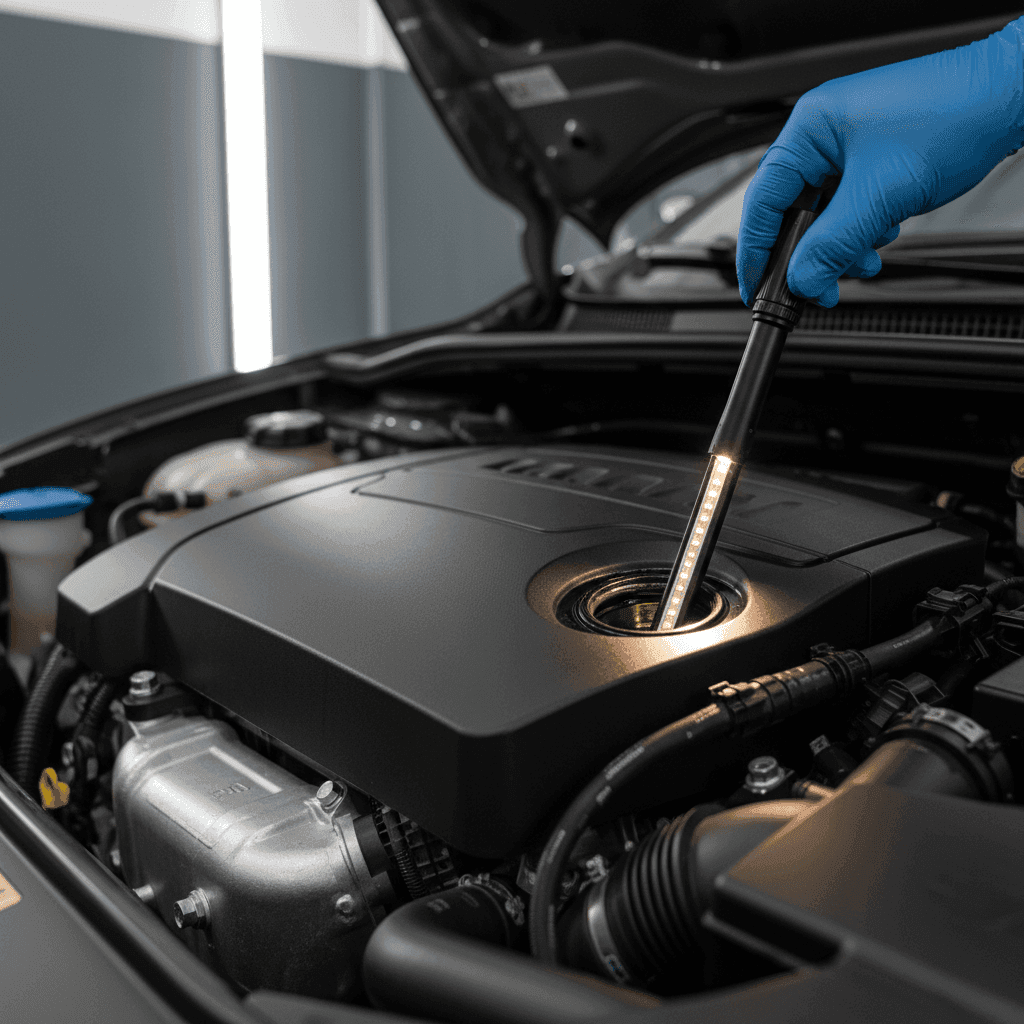
Between 2022 and 2023, Stellantis recalled more than half a million vehicles across Europe over the wet timing belt on PureTech 1.0 and 1.2 engines, which disintegrates in the oil and clogs the oil pump. If you are looking at a used Peugeot 208, Citroen C3 or Opel Corsa F with a petrol engine, that is exactly the engine offered in 9 out of 10 listings. This guide shows which models and years have the problem, what Stellantis covers and how to tell, before you put down a deposit, whether the car in front of you is a time bomb or a sound buy.
This guide was put together by the Auto Gas Gaga workshop in Banja Luka, based on public Stellantis sources, European automotive media and our experience inspecting used vehicles imported from the EU.
Table of Contents
- What the Wet Belt Is and Why It Is a Problem
- Which Models and Years Have the Problematic PureTech
- EB2 Generations: How to Tell Belt from Chain
- Symptoms of Belt Degradation in Oil
- Stellantis Compensation: Who Qualifies and How to File
- What to Check Before Buying a Used PureTech
- Shortened Service Intervals and How to Extend Engine Life
- Should You Buy a Used PureTech or Walk Away
- Frequently Asked Questions
- Related Articles
What the Wet Belt Is and Why It Is a Problem
On most engines the timing belt runs dry, outside the engine housing. For its small three-cylinder PureTech family (internal designation EB) Stellantis went a different route, placing the belt inside the engine where it is bathed in oil. The idea was to reduce friction and noise, lower emissions, and in theory extend belt life.
In practice the opposite happened. Over time the rubber compound softens and starts to flake off in contact with the hot oil, especially once the oil is even slightly past its prime. Small pieces of rubber end up on the oil pump pickup screen. The screen clogs, oil pressure drops, the engine starts to knock and in the worst case it lets go. Repair at that point usually means a rebuild that exceeds the value of the car itself.
The worst part is that the owner sees nothing, and according to the service book everything is in order, because the manufacturer scheduled the belt replacement only at around 112,000 km. Many cars failed well before the first scheduled change.
Which Models and Years Have the Problematic PureTech
PureTech was the main Stellantis petrol engine for the compact class across an entire decade, so it affects practically every popular used Peugeot, Citroen, Opel or DS with a 1.0 or 1.2 petrol from that period.
Main models with the at-risk engine (production roughly 2012-2023):
- Peugeot: 208 (first and second generation), 2008 (first and second), 308, 3008, 5008, 301, Rifter
- Citroen: C3, C3 Aircross, C4, C4 Cactus, C4 Picasso, C5 Aircross, Berlingo
- Opel/Vauxhall: Corsa F, Astra K (late version), Mokka (from 2021), Crossland, Grandland
- DS: DS 3, DS 4, DS 7 Crossback
- Jeep: Avenger (new generations with an engine from the same family)
In BiH the most common are the Peugeot 208/2008 and Citroen C3, plus the Opel Corsa F, which is technically the same car as the 208 under a different shell. If the car was imported after 2019, there is a strong chance it has the PureTech with a wet belt.
It is important to state upfront what is NOT affected. The 1.5 BlueHDi and 1.6 BlueHDi diesel engines do not use this design. The older naturally aspirated 1.2 VTi petrol (no turbo) is also a different engine. The problem is strictly tied to the turbo three-cylinders with the internal designation EB2 (1.2) and EB0 (1.0).
EB2 Generations: How to Tell Belt from Chain
Stellantis has been rolling out a fix gradually. From 2023, production began of the Gen 3 EB2 where the wet belt has been replaced by a chain, the classic solution that does not break down in oil. The principle is similar, the same engine family, but the execution and typical failures differ between generations. The wet belt did not disappear overnight, and through 2024 and 2025 the belt-driven engine was still being fitted in part of new production, especially in non-hybrid variants.
How to Recognise a Gen 2 PureTech with a Wet Belt
For a used car coming into BiH from EU imports, this is the decisive check. Three practical indicators:
- Year of manufacture. Anything up to and including 2022 is almost certainly the wet belt. 2023 is a transition year, depending on the production batch and market. 2024 and 2025 are mixed, do not take it for granted that it is a chain.
- Service book. A Gen 3 with a chain does not call for timing replacement within the expected service life. If the service book lists a scheduled item for "timing belt replacement", the engine is a belt-driven version.
- Engine badge. For the new generation Stellantis has begun moving away from the "PureTech" name, so an engine under a new designation (e.g. "T3 Hybrid") usually signals a chain. If it still says "PureTech 130" or "PureTech 110", it is almost certainly the belt version.
The most reliable check is by VIN with a dealer query. Stellantis service centres can identify the exact engine version from the VIN. We have written about the difference between belts and chains in our advice piece on timing chain or belt replacement.
Symptoms of Belt Degradation in Oil
Most owners first notice oil consumption. The factory norm is roughly 250 ml per 1,000 km in the worst case, while owners with a failing belt report a litre per 1,000 km and more. Oil simply disappears off the dipstick, with no visible leak under the car and no blue smoke in the exhaust.
The second and more dangerous sign is engine knocking on cold start, in the first few seconds. That is the moment when the hydraulic lifters are waiting for oil pressure to arrive, and a clogged oil pump pickup delays delivery. If the knock lasts a couple of seconds and then disappears, the suspicion is already serious.
Excessive Oil Consumption on the PureTech Engine, Symptoms You Should Not Ignore
The third group of symptoms covers starting issues and rough idle, plus sometimes a check engine light with a code for the timing system or camshaft sensor. Those codes do not always mean a wet belt, but combined with elevated oil consumption they raise a serious alarm.
The worst scenario is a quiet arrival at the workshop. The engine "drops" without warning, the oil pump has given up, and the damage is in the cylinder head. At that point the conversation is about replacing the entire engine assembly, no longer about repair.
Stellantis Compensation: Who Qualifies and How to File
Under pressure from European consumer associations and the media, Stellantis opened an official compensation platform in March 2024. In May 2025 it was formally extended to cover the whole of Europe. For now this is the clearest route for an owner to recover the money paid for a repair.
Key points:
- Extended warranty. For previous generations of the 1.0 and 1.2 PureTech engines, Stellantis introduced extended coverage of 10 years or 180,000 km, whichever comes first. Within that window the manufacturer covers 100% of parts and labour cost for a recognised failure through an authorised service centre.
- Retroactive payout for repairs already paid. The compensation applies to repairs carried out in the window of 1 January 2022 to 31 December 2024. If during that period the owner paid for a repair out of pocket, they have the right to file the invoice and request a refund.
- Brands. Peugeot, Citroen, DS, Opel and Vauxhall. Jeep is handled through its own channel.
- Where to file. The Stellantis platform at stellantis-support.com has a form for submitting a claim. You will need the VIN, proof of ownership, the service invoice and contact details.
What the policy does not cover is just as important as what it does. Repairs outside the 2022-2024 window are not included in the retroactive payout. A car bought in 2025 or 2026 with an already failed engine is handled through the extended warranty via an authorised service centre. Service work performed at an independent workshop most often loses entitlement to coverage.
How to File a Claim with the Stellantis Compensation Platform
Practical sequence for an owner in BiH who paid for a repair between 2022 and 2024:
- Gather all documentation: the bill of sale and registration in your name, the service invoice itemising parts and labour, plus any photographic evidence you still have.
- Open a claim on the official platform. The form is in English and several EU languages.
- Be prepared for Stellantis to ask for the VIN and possibly request an additional check through the authorised service network.
- Response time on claims from the UK and France is measured in weeks rather than days.
What to Check Before Buying a Used PureTech
A used 208, 2008, C3 or Corsa F imported from the EU is a common choice in BiH today. The wet belt does not mean running from every example, but it does mean the inspection has to be more thorough than usual.
Before you hand over a deposit, work through this sequence:
- Service history. Look for paper, not stories. Cars that had their oil changed regularly at 10,000 km instead of the factory 25,000-30,000 km do dramatically better.
- Oil level check on a cold engine. If the level is below minimum and the owner claims they topped it up recently, that is a major warning sign. Ask how often they top it up.
- Oil condition through the filler neck. Remove the cap and look for anything like black sludge or rubber particles on the inside of the cap. The difference between clean oil and oil with debris is visible even without experience.
- Engine knock on cold start. Insist on starting the car yourself, with the engine completely cold (ideally after sitting overnight). Listen for the first 10 seconds.
- Oil leaks under the engine. A wet belt also affects seals, prolonged loss of pressure tends to drag oil-soaked seals with it.
- Invoices for shortened oil services. Owners who knew about the problem most often shortened the interval and kept the invoices. That is a big plus.
Used cars imported from the EU are also worth checking through a documented vehicle history. A pre-purchase inspection at a workshop reveals the current state of the engine, but mileage by year, registered accidents, number of previous owners and indicators of theft or write-off damage are most easily verified through a carVertical report by VIN. With the PureTech it is especially important to see whether the car has already been through a major service abroad, because an EU service invoice falls within the Stellantis compensation window. We consider this mandatory before buying any used car from imports. When paying for the report you can use the code GAGA and get a 20% discount.
If a car passes this filter and its paperwork is clean, a used PureTech can be a reasonable choice, provided you accept a shortened service schedule. For a broader approach to buying used, see our used car inspection checklist. If anything sounds off, book an inspection before the deposit.
Shortened Service Intervals and How to Extend Engine Life
The factory oil change interval on this engine is long, up to 25,000 km or 30,000 km and up to two years. Independent experts in automotive media and specialised workshops (BUCO, AutoRepublika, MotoFocus.hr) have for years openly recommended halving that interval. This is not an official Stellantis recommendation, it is a consensus from workshops that see these engines every day.
Shortened Oil Interval for PureTech, 10000 or 15000 km
The practical recommendation most often heard:
- Oil and oil filter: 10,000-15,000 km or once a year, whichever comes first. In city driving with lots of short trips lean toward the lower end, in motorway driving you can lean toward the upper end.
- Synthetic oil with high thermal resistance, in the viscosity the manufacturer specifies (most often 0W-30 or 5W-30 to the appropriate ACEA standard). Saving on oil here is saving that costs you the engine.
- Timing belt: 60,000 km or 6 years instead of the factory roughly 112,000 km. With that replacement the oil pump is also changed, the pickup screen is cleaned or replaced, and the seals that come with the kit are renewed.
The combination of shortened oil service and preventive belt replacement significantly reduces the chance of the engine "dropping" without warning. The cost depends on the specific engine and scope, so for a quote get in touch with the workshop.
There is also a third option that has been talked about in the last two years, conversion of the wet belt to a chain. The Dutch firm Oudeschild is developing the ProChain kit, with first deliveries due in the second half of 2026. For now it is an interesting prospect rather than a mass solution, and it will be a while before it becomes cost-effective for the average 208 or C3.
Should You Buy a Used PureTech or Walk Away
The honest answer depends on the specific car and what kind of buyer you are.
Buying a used PureTech makes sense if:
- The car is from 2023 or later and you can confirm by VIN that it is the Gen 3 with a chain.
- The car is older but has a clear service history with shortened oil intervals and, ideally, a preventive belt replacement already done.
- You are prepared to accept a shortened service regime at 10,000-15,000 km and to change the belt before the factory deadline.
- The price already prices in the risk, that is the car is noticeably cheaper than an equivalent Golf, Polo or Ibiza with the same mileage.
It is smarter to walk away if:
- The car has no service book, or it only carries stamps without details.
- The owner tops up oil between services and is not aware that this is a problem.
- The price is the same as or higher than competitors from the VAG or Toyota groups, because in that range you have a safer choice.
- You want a car you will service every two years and not think about the engine. PureTech is not the right choice for that.
The wet belt is not a death sentence, but it is information that has to enter the calculation. A buyer who knows and buys consciously usually does well, while one who discovers the problem six months later will pay the price in both time and money.
Looking at a specific used 208, C3, Corsa F or Mokka? Book a pre-purchase inspection with the listing link and full service history before you put down a deposit.
Frequently Asked Questions
Which engines exactly have the wet belt, and which do not?
The wet belt is on the Gen 1 and Gen 2 versions of the EB2 (1.2 turbo) and EB0 (1.0 turbo) engines, produced roughly 2012-2023. The Gen 3 EB2 with a chain starts in 2023, but belt-driven engines were still being fitted into part of new production in 2024-2025, especially in non-hybrid versions. The older naturally aspirated 1.2 VTi and all diesel engines (1.5 BlueHDi, 1.6 BlueHDi) do not have this problem.
Does the Stellantis compensation cover a car bought in BiH through a used import?
It does, if the conditions are met. The key items are the VIN, proof of ownership and an invoice for a repair carried out between 1 January 2022 and 31 December 2024. The place where the car was bought is not decisive, what matters is where the repair was done and whether it was documented with a breakdown of labour and parts. Filing goes through the official Stellantis platform.
How much does a timing belt replacement on a 1.2 PureTech cost?
The price depends on the specific engine, year and scope of work (the belt is often accompanied by the oil pump, balance shaft chain, seals and oil). The figure varies between the authorised network and independent workshops, so for a realistic estimate get in touch with the workshop with the specific model and year.
Is it enough to just shorten the oil interval, or do I have to replace the belt earlier?
A shortened oil interval is mandatory, but on its own it is not enough on an already older car. A preventive belt replacement at around 60,000 km or 6 years, together with replacing the oil pump and cleaning the pickup screen, is the second layer of protection. The closer the car is to, or past, the factory interval (around 112,000 km), the more urgent the preventive replacement becomes.
What is the difference between the Stellantis compensation and a standard warranty?
The standard factory warranty on this engine has long expired for most used cars on the BiH market. The Stellantis compensation is a separate scheme on top of the warranty, an extended coverage to 10 years or 180,000 km plus a retroactive payout for repairs in 2022-2024. It goes through a separate platform and requires documentation, not through the dealer warranty process.
What if I already paid for a repair in 2023 in BiH but the invoice is in a friend's company name?
The Stellantis platform requires proof of ownership and an invoice in the owner's name or in a company with a clear link. An invoice in a third party's name usually does not pass. If the invoice is in a legal entity's name, there has to be a clear link between the company and the owner at the time of repair. Before filing, talk to the workshop about possibly reissuing the invoice in the actual owner's name.