Every decision about servicing a used car in BiH ends up at the same question. Should you take the original box from the manufacturer's catalogue, or one of the cheaper options from a supplier's shelf? The price gap for the same set of brake discs and pads can be three times over, yet the car stops within the same distance in both cases. This guide explains exactly what the labels OE, OEM, OES and aftermarket mean, when it pays to spend more, and when an original box would be throwing money away, especially in BiH where the average car age is around 17 years.
This guide was put together by the Auto Gas Gaga workshop in Banja Luka, based on day-to-day experience choosing parts together with owners of used cars for each specific job.
Table of Contents
- Why This Question Matters for the BiH Driver
- OE, OEM, OES and Aftermarket: What These Labels Really Mean
- Price Tiers: From the Factory Box to the Cheapest Aftermarket
- Reputable Aftermarket: Who Actually Makes the Parts in Your Car
- Brake Pads, Discs and Suspension: Where ATE, Bosch or TRW Pay Off
- Filters and Consumables: Mann, Mahle, Knecht Instead of the Factory Box
- Electronics, Sensors and Lambda Probes: Do Not Save Here
- Tie Rod Ends, Control Arms and Ball Joints: Lemforder and Meyle as the Standard
- What to Never Cut Corners On: Turbo, Injectors, Safety Parts
- How to Read an OE Number and Find the Equivalent
- Where to Buy in BiH: Online vs Local Suppliers
- Frequently Asked Questions
- Related Articles
Why This Question Matters for the BiH Driver
The average vehicle in BiH is around 17 years old and has over 200,000 kilometres on the clock. That means every service, small or large, is a compromise between what the manufacturer would ideally recommend and what makes sense to invest in a car that is on its third or fourth owner. An original box with the carmaker's logo sounds like a safe choice, but for a 10,000 KM used car a set of original discs and pads that costs as much as a household's monthly budget simply does not stack up in a healthy calculation.
A study published by Klix in 2024 confirmed what workshops in BiH have known first-hand for years. More than 90 percent of consumers choose aftermarket parts because of more accessible prices. Reputable aftermarket brands often come off the same production lines as the parts in factory boxes: same factory, same material, different packaging, different price.
Another reason the decision matters more in BiH than in Germany is the structure of the market. Major online suppliers in BiH such as Auto24.ba hold catalogues with over two million items dominated by Liqui Moly, Bosch, Sonax, Castrol, Mobil, Continental and Textar. Factory boxes are practically not on offer there, because nobody asks for them at that price. A driver who insists on the original has to go through an authorised dealer, where the dealership's markup is added on top of the part's price, so the final bill can be twice as high.
OE, OEM, OES and Aftermarket: What These Labels Really Mean
The biggest misconception is that "original" is one category and everything else is a cheap Chinese copy. In reality there are four clearly separated tiers, and each has its place.
OE (Original Equipment) is the part in the carmaker's factory box. The box says Volkswagen, BMW, Mercedes or Toyota. The price is the highest because you are paying for the whole chain from the parts factory through the distributor to the authorised dealer. The part itself was, in 99 percent of cases, made by some third party - an external supplier.
OEM (Original Equipment Manufacturer) is that exact same part, off the same production line, but in the box of the company that produced it. The Bosch that made the MAF sensor for VW also sells that sensor in a Bosch box under its own OEM number. Compared to the OE version, the price is typically 10 to 20 percent lower; the material is the same, the tolerances are the same, the parts manufacturer's warranty is the same.
OES (Original Equipment Service) is a less well-known label, but it matters. It is an OE part sold as a service replacement part, not as a part that goes into the factory for a new car. It is often produced in smaller batches, with the same tolerances. In practice OES is almost identical to OE for the driver, just without the factory box.
Aftermarket (AM) is everything else: parts made as an alternative to the OE line, not necessarily in the same factory, not necessarily to the same tolerances. The quality range here is the widest, from reputable brands that themselves supply carmakers, to the cheapest budget brands that tests occasionally show as too short and unsafe.
The key thing to understand is that the boundary is not OE versus AM. The boundary is: reputable aftermarket from a confirmed OE supplier versus anonymous aftermarket without certification. The first is, in 9 out of 10 services, an excellent choice; the second is the reason a pad squeals when cold after just six months.
Price Tiers: From the Factory Box to the Cheapest Aftermarket
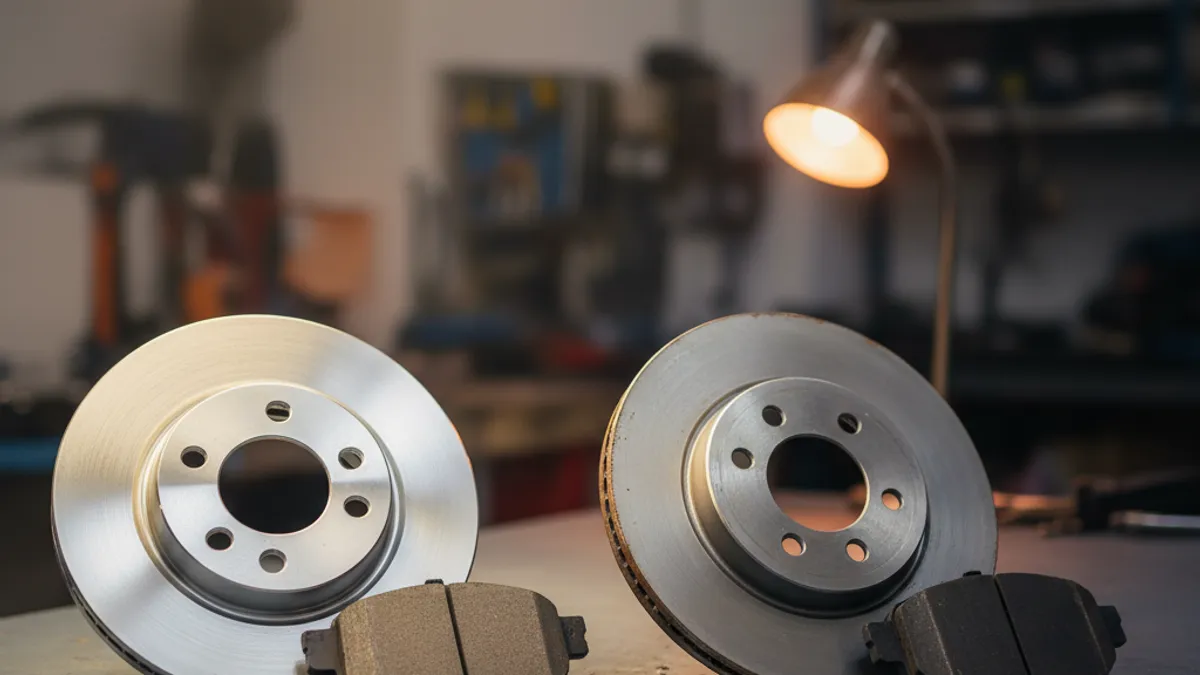
A concrete example from the ADAC test published in 2025 illustrates what has been visible in workshops for years. A set of brake discs and pads for a Golf, originally from the VW factory box, costs around 432 EUR according to the test relayed by automobili.ba. Behind that part stands the manufacturer TRW, which means Volkswagen does not make the discs itself but buys them from TRW and resells them in its own box. The most important result of the test is that a set of ATE Ceramic pads and discs cost 250 EUR in the same test and won the test on braking effectiveness. The original set is more than four times more expensive than the cheapest tested set, and does not offer a proportional advantage. ADAC measured this on tarmac, not in marketing.
The practical division we use in the workshop:
- Premium aftermarket (Bosch, ATE, Textar, Mann, Mahle, Knecht, Lemforder, TRW, Brembo, Continental). Price in the OEM range or just below. Quality identical to what goes into the factory line.
- Mid-tier aftermarket (Meyle, Febi, Bilstein, Lesjofors, Mapco, Ferodo). Price 30 to 50 percent lower than premium. Quality entirely usable for most jobs on a used car, especially in Meyle HD or PD versions.
- Budget aftermarket (Starline, Comline, Mapco budget line, Maxgear). Price 50 to 70 percent lower than premium. Acceptable for some categories where the load is not critical, dangerous for brakes and safety parts without ECE R90 certification.
- Unknown brands without certification. We do not use them. It is not worth the risk for a 10 KM difference on a brake pad.
The goal is not always cheapest nor always original; the goal is to match each part to the tier that fits its function.
Reputable Aftermarket: Who Actually Makes the Parts in Your Car
Most drivers do not know that the big OE suppliers are at the same time the biggest aftermarket brands. The auto parts industry is consolidated around a few large groups that supply carmakers and sell to workshop customers under their own brand at the same time.
A list of the main OE suppliers that simultaneously form the backbone of quality aftermarket:
- Continental for electronics, sensors, ignition, air conditioning systems, ABS sensors.
- Bosch for ignition, injectors, MAF sensors, lambda probes, alternators, batteries, diesel pumps, brake components.
- Schaeffler group (brands INA, LuK, FAG) for timing belt kits, clutches, bearings.
- ZF group (brands Sachs, Lemforder) for clutches, shock absorbers, suspension, ball joints, tie rod ends.
- Denso for air conditioning, alternators, lambda probes (especially for Toyotas and Japanese makes).
- TRW for brakes, suspension, safety systems.
- ATE for brakes (OE supplier to BMW, Mercedes, VW).
- Mann, Mahle, Knecht for filters (OE suppliers to almost every European manufacturer).
- Brembo for brakes, especially for sports models.
- Bilstein for shock absorbers (OE for Mercedes and many premium brands).
- Valeo for air conditioning, wipers, alternators, clutches.
By vehicle make, the profiles differ. Mercedes uses JURID, TRW and Brembo on brakes, MANN on filters, BILSTEIN on shock absorbers. The VW group most often uses TRW on brakes, INA and LuK on timing and clutch, SACHS on shock absorbers, KNECHT and MAHLE on filters. BMW uses ATE on brakes, LEMFORDER on suspension. Fiat, Alfa Romeo and Lancia lean on BREMBO and DAYCO.
When at the workshop you see the mechanic offering ATE pads for a BMW or a LuK clutch for a Golf, that is not a compromise. It is literally the same part that would come in the factory box, just without the factory markup. The compromise would be taking an unknown brand for half the price.
Brake Pads, Discs and Suspension: Where ATE, Bosch or TRW Pay Off
The brake system is the clearest example of where smart aftermarket beats the factory box. The ADAC test has already been mentioned, but we reach the same conclusion in daily work. ATE Ceramic, classic ATE, Bosch and TRW pads on European cars deliver braking that the driver does not distinguish from factory, wear in a similar interval, and do not produce more dust than specified.
The difference between lines within the same brand also matters. ATE Ceramic, for example, makes less dust and runs more quietly, but lasts somewhat shorter than the classic ATE line and has a different cold friction coefficient. For city driving it is an excellent choice; for heavy load or constant motorway use, classic ATE pads can be more rational.
For discs the principle is similar. ATE and Brembo discs are practically OE quality, just without the carmaker's logo. Budget brands on heavier cars and in mountain driving sometimes show deformation after hard braking while hot.
Brake components must carry the ECE R90 certification (on newer boxes marked UN R 90), a European homologation that guarantees minimum braking safety. Without that mark we do not fit the part, however cheap it is.
A safety rule with no exception: on one axle, the same brand and the same line of pads go on, along with discs of the same brand. Mixing brands on the left and right sides means different friction coefficients, and the car pulls to one side under hard braking. We do not do that.
Filters and Consumables: Mann, Mahle, Knecht Instead of the Factory Box
Filters are a category where the factory box makes absolutely no sense. The reason is simple. Mann, Mahle and Knecht effectively cover the entire European filter industry. An oil filter in a factory VW box, an oil filter in a Mahle box and an oil filter in a Knecht box are, in 95 percent of cases, the same piece of paper in the same plastic housing. The price in the first box is twice as high.
On the 1.9 TDI engine, the most common diesel engine in BiH workshops, a Knecht or Mahle oil filter is literally the OE part; Mann is an OE alternative of the same quality. The cheapest unknown-brand filters do not have the same paper, nor the same filtration surface. The oil filters worse, the engine ages faster, and a small initial saving later costs you an oil pump replacement.
The same rule applies to:
- Air filter. Mann, Knecht, Mahle, K&N (for the sport line). The flow difference between premium and budget brands is measurable.
- Fuel filter. Mann or Bosch. Especially on a diesel with a Common Rail system, where a poor fuel filter directly means a shortened life for expensive injectors.
- Cabin pollen filter. Mann, Mahle, Knecht. The difference in paper quality is felt during allergy season.
As for engine oil, Liqui Moly, Castrol, Mobil 1, Shell, Total and Motul are proven choices for most engines. We wrote more about change intervals in our guide on oil, filters and fluids; the general rule is that you do not save on oil.
Electronics, Sensors and Lambda Probes: Do Not Save Here
Electronics is the category where you most easily see the difference between a serious supplier and an imitation. Lambda probe, MAF sensor, MAP sensor, crankshaft or camshaft sensor, ABS sensors, EGR valve with electric actuator. These are all parts where a wrong reading from the sensor ruins the operation of the whole system.
Lambda probes are bought exclusively from Bosch, NTK or Denso. These are the three manufacturers that supply almost the entire European and Japanese industry. An unknown lambda probe from the cheapest tier may work for six months, then start giving wrong values, which affects the mixture, consumption, emissions, and ultimately the catalytic converter. An original Bosch or NTK lambda probe lasts 100,000 to 150,000 km. A small initial saving here turns into a catalytic converter replacement.
MAF and MAP sensors. Same principle, Bosch or Denso, possibly Hella, which also has an OE programme. Anything else on these sensors is not a saving but a shortening of the time to the next failure.
ABS sensors and wheel speed sensors. Here aftermarket from known brands such as Hella, ATE or FAE works well. With unknown brands you often get unreliable readings, which trigger intermittent ESP and ABS warning lights.
Ignition coils and spark plugs. Bosch, NGK, Beru or Denso. Certain VW engine generations are known for chewing through poor ignition coils in a matter of weeks.
The rule is simple: if a part controls engine operation or braking, you do not go below a reputable brand. The price difference is usually small, the service life three to five times longer.
Tie Rod Ends, Control Arms and Ball Joints: Lemforder and Meyle as the Standard
Suspension is a category where mistakes are often made. The tie rod end, control arm, ball joint and stabiliser links are constantly under load, exposed to water, salt and road slush. The quality of the metal and the rubber on the joint directly determines how long the part will last before it starts knocking.
Lemforder is an OE supplier for most European makes, from BMW and Mercedes to the VW group. A Lemforder tie rod end is exactly what comes from the factory with a new car, just in a Lemforder box and at a significantly lower price than the factory box.
Meyle, especially the Meyle HD line, is another strong option. Meyle HD is a line of reinforced parts designed to last longer than OE, with double the warranty. For our roads, where suspension takes a beating from uneven surfaces, Meyle HD is in many cases a better choice than even the factory tie rod end.
Febi Bilstein is another reputable mid-tier option, a good compromise when the budget does not allow Lemforder. TRW and Moog also make quality suspension parts, especially for French and German cars.
Tie rod ends are always replaced in pairs. A car with a new tie rod end on only one side shows an imbalance in geometry and wears tyres unevenly.
What to Never Cut Corners On: Turbo, Injectors, Safety Parts
There is a clear list of parts where the budget aftermarket conversation does not even open. For the owner every saving is false here, because it multiplies later.
Turbocharger. Exclusively OE or the actual original manufacturer (Garrett, BorgWarner, IHI, Mitsubishi). These four companies made the original turbo on your car in 99 percent of cases. Generic aftermarket turbos can let oil through after a few months, which on a Common Rail diesel ends with the oil burning in the intake manifold and the engine going into runaway.
Common Rail injectors and pump-injector systems. Only Bosch, Denso, Siemens VDO (now Continental) or Delphi, exactly the manufacturer originally fitted. The injector is a hydromechanically precise part with tolerances measured in micrometres; generics from unknown sources can have wrong spray patterns, which damages the engine.
Cylinder head gasket. Original or Elring, Reinz, Victor Reinz - these are the OE gasket suppliers to all European makes.
Brake hydraulics (brake callipers, master brake cylinder, brake servo). OE or ATE, TRW, Brembo. A safety part where a failure has only one outcome.
Timing belt and full kit. INA, Gates, Continental or Dayco. The belt, tensioner and water pump kit is taken as a single kit from one manufacturer; we do not mix brands. A timing belt that gives way is the reason engines get replaced.
Airbag, seatbelts and the Start Stop battery. Airbag and seatbelts exclusively original or through an authorised supplier; there is no cheap equivalent. For a Start Stop system you use an AGM or EFB battery of a reputable brand; a classic cheap battery does not do that job and damages the electronics.
How to Read an OE Number and Find the Equivalent
A practical step for a driver who wants to track what is being bought for their car is learning to read the OE number. This is the number the carmaker assigns to a specific part in its catalogue, printed on the part itself and on the factory box.
Example: a VW brake disc for a fifth-generation Golf carries the OE number 1K0 615 301 T (with variants for front right, front left, rear). That number is entered into the online catalogue of a reputable supplier and the system returns a list of equivalent parts from other brands. The equivalent at Bosch is typically in the range of 0 986 479 C21. Both numbers describe a functionally identical disc: same dimensions, same thickness, same material.
The web catalogues of major suppliers have a field for cross-referencing the OE number. Enter the OE number from the factory and you get an offer from five to fifteen brands with prices. That is the moment when you see how much the brand difference costs, not the quality.
Another approach is searching by VIN number (chassis number, 17 characters, on the windscreen or in the registration document). The VIN system identifies your exact model and returns a list of parts that fit. A third approach, which we use in the workshop, is via the TecDoc database, an industry database that maps OE numbers to all available aftermarket equivalents.
Where to Buy in BiH: Online vs Local Suppliers
The spare parts market in BiH in 2026 has split between online platforms and local suppliers with physical warehouses. Each channel has its role.
Online suppliers in BiH and the region (Auto24.ba and similar) hold the largest assortment, up to two million items at the biggest ones, with premium brands as part of the standard range. The advantages are choice, the ability to cross-reference by OE number, and availability of rarely-requested parts. The drawback is delivery time and the fact that for certain rare parts the ordered item is not exactly the one the order specified. We always ask for the OE number when ordering and verify it on the part before fitting.
Local suppliers in Banja Luka, Sarajevo, Tuzla and larger cities keep the most frequent spare parts in stock: filters, pads, batteries, oils, tie rod ends for the most popular models. The price is sometimes a little higher than online, but in return you get the option to buy and fit the part the same day. For urgent situations, a local supplier is almost always the better choice.
Online from abroad (autodoc.de, oscaro.com, kfzteile24, mister auto). Prices can be significantly lower for premium brands. The drawback is delivery time, customs and VAT paid on import, and the potential complication if a part is delivered incorrectly and has to be returned abroad. For planned work, where the driver knows in advance what they need, this channel can deliver 30 to 40 percent savings on larger orders.
Dealerships and authorised service centres. The highest price, factory box and factory warranty. It only makes sense for rare parts where no aftermarket exists, or while the vehicle is still under factory warranty.
At the Auto Gas Gaga workshop, for every service we show the owner the OE, OEM and reputable aftermarket options with prices and expected life, and we make the decision together. An owner who understands the difference between a Bosch pad and an unknown brand makes a better decision for their car than one who just hears "we used original, do not worry".
If you are thinking about a larger service on your car or a pre-purchase inspection of a used car, book an appointment at the workshop or write to us via the contact form before you buy parts on your own, so we can look together at what is worth investing in and what makes no sense on your specific car.
Frequently Asked Questions
What exactly does the OEM label on a box mean?
OEM (Original Equipment Manufacturer) means the box is produced by a company that is at the same time a factory supplier of original parts to carmakers. The Bosch that supplies injectors to Volkswagen also sells those injectors in a Bosch box under its own catalogue, and that is the OEM version. Functionally the part is identical to the one in the factory VW box; the difference is in the logo and the price (OEM is typically 10 to 20 percent cheaper).
Do Bosch pads match the originals on a Golf?
Yes, in practice the difference is only in the box and the price. Bosch is one of the OE suppliers to the VW group, so Bosch pads go on sale as an alternative to the original with entirely the same or very similar specifications. The only thing that matters is taking the Bosch line that matches the year and engine of your Golf, and on a single axle the same brand and same line of pads must be fitted.
What is the difference between ATE Ceramic and classic ATE pads?
ATE Ceramic uses a ceramic-organic friction material that produces visibly less black dust on the wheels and runs more quietly, but has a different cold friction coefficient and on average wears somewhat faster under intense driving. Classic ATE pads use a traditional semi-metallic material that copes better with high temperatures and heavy loads. For city driving Ceramic is an excellent choice; for motorway, mountains or carrying loads, classic ATE pads have the edge.
Which filters should I buy for a 1.9 TDI engine?
For the 1.9 TDI engine (PD and Common Rail variants), Mann, Mahle, Knecht or Bosch filters are the first choice and are effectively OE equipment. An oil filter in a Mahle or Knecht box is the same piece that goes into the manufacturer's factory box. The fuel filter on a diesel is particularly important and there we use only reputable brands. A cheap fuel filter directly shortens the life of expensive PD pump-injector units or Common Rail injectors.
Can OE and aftermarket pads be mixed on the same axle?
No, never. On one axle the same brand and same line of pads must be fitted. Different brands or lines have different friction coefficients, which under hard braking can pull the car to one side. This is a safety rule with no exception. Pads on the left and right sides are always replaced together; if only one side is worn, the full set is replaced anyway.
Original VW disc vs Bosch in the ADAC test, what were the results?
In its 2025 brake system test, ADAC compared the original VW set of discs and pads (made for VW by TRW) with sets from reputable aftermarket brands. The original set cost around 432 EUR according to the report relayed by automobili.ba, while an ATE Ceramic set cost 250 EUR and won the test on braking effectiveness. The conclusion is that the original set is more than four times more expensive than the cheapest tested set, and does not offer a proportional advantage in braking.