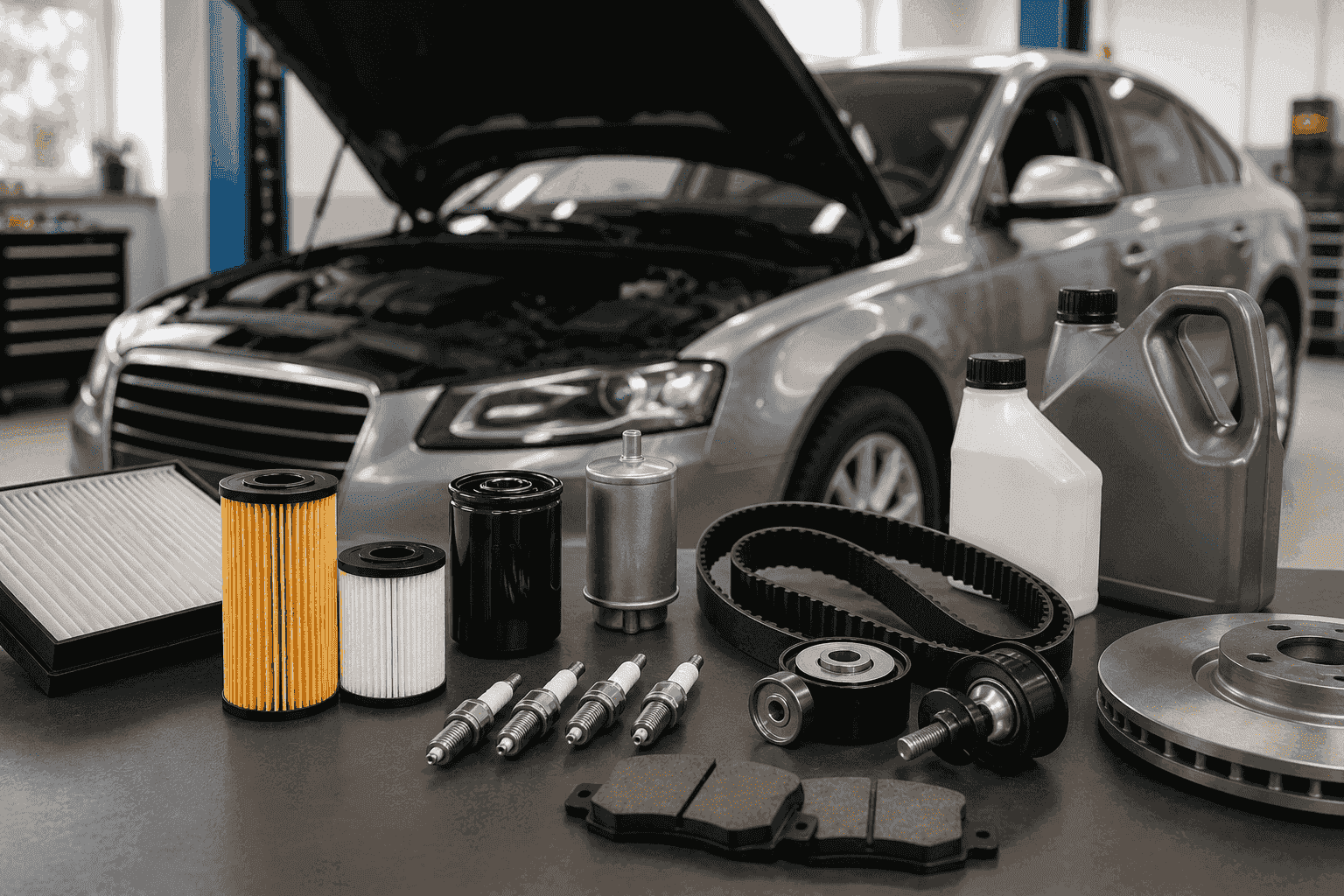
Most used cars that come into our workshop have between 180 and 280 thousand kilometres, are model years 2008 to 2014, and carry a service booklet with "regularly maintained at an authorised service centre" written in it, but without a single concrete invoice. Then the customer sits down, says "the car drives perfectly", and asks what now. This guide is the answer to that question, organised by mileage thresholds: what your car is asking for now, what comes due next year, and when it makes more sense to say stop than to keep pouring money into an engine that is no longer worth it. Maintaining a used car by mileage is not the same as maintaining a new car by the service booklet, and the difference costs you either in the parts you skip or in the breakdowns that catch you out on the road.
This guide was put together by the Auto Gas Gaga workshop in Banja Luka, based on thousands of pre-purchase inspections and services of used cars that we see in the bay year after year, plus the threshold guides for 100, 150, 200 and 250 thousand kilometres that we published throughout 2026.
TL;DR
| Topic | In short |
|---|---|
| Service plan vs factory booklet | A used car with 200-280 thousand km needs shorter oil intervals, earlier timing service and an EGR/DPF check that the booklet does not mention. |
| Three key mileage thresholds | 100,000 km = first major service (timing, water pump, filters); 150-200 thousand km = EGR/DPF + dual-mass flywheel for most diesels; over 250,000 km = we talk about economic viability. |
| LPG on a petrol engine | Shortens valve life and calls for more frequent spark plug service; regular LPG service with a properly tuned map extends engine life more than owners often think. |
| DSG and CVT gearboxes | Have their own service intervals separate from the engine; skipping DSG oil at 60-90 thousand km is the most common cause of an expensive mechatronic failure. |
| The 40 to 50 percent rule | When the next repair costs more than half the car's market value, sell before servicing. This guide helps you reach that point as late as possible. |
Table of Contents
- Why a Used Car in BiH Needs a Different Service Plan
- Complete Guide by Mileage Thresholds
- What to Do Right After Buying a Used Car
- Major and Minor Service, the Difference and When to Do Which
- Differences by Drivetrain: Diesel, Petrol, Petrol with LPG
- Differences by Gearbox: Manual, DSG, Automatic, CVT
- Red Flags That the Car Was Not Regularly Serviced
- When to Say Stop: the 40 to 50 Percent of Car Value Rule
- Frequently Asked Questions
- Related Articles
Why a Used Car in BiH Needs a Different Service Plan
The factory service booklet is written for one scenario: an owner who buys the car new, drives it in conditions similar to those the car was tested in, and sticks to the recommended intervals from the day of delivery. A used car in BiH almost never fits that profile.
First, the age. A car that covered its first 150 thousand kilometres in Germany on motorways without potholes, with the same owner and the same service centre, arrives in BiH with 220 thousand on the clock and enters a completely different driving regime. Shorter trips, more idling in the queue through central Banja Luka, roads that wear out shock absorbers and suspension, fuel that is sometimes not top quality, and air conditioning running at maximum for three summer months. All of that accelerates wear on parts the factory booklet never accounted for.
Second, the service history. Most used cars that come into the workshop have no documented history of gearbox oil changes, antifreeze, timing kit, or brake fluid. From the seller's point of view, those records are not mandatory; from the buyer's point of view, they are the difference between a car that will run another 100 thousand kilometres and a car that will demand a repair more expensive than the deposit within a year.
Third, the myth of lifetime fluids. For years manufacturers pushed the story that the oil in a DSG gearbox, the antifreeze, or even the brake fluid was "lifetime". Lifetime there means one thing: enough for the car to make it through the two-year warranty and the first 100 thousand kilometres. What happens after that is the owner's problem. When such a car with 200 thousand arrives on the BiH market, the buyer inherits 100 thousand kilometres of skipped service without knowing it.
A service plan for a used car therefore does not start from factory intervals. It starts from the assumption that anything not documented was probably skipped, and that mileage thresholds are not a suggestion but a working order through which you get back on track. For the logic of oil, filters and brake fluid in everyday driving see our guide on the intervals for changing oil, filters, brake fluid and antifreeze. That is the reference we recommend you read before getting into a more serious major service.
Complete Guide by Mileage Thresholds
This guide exists to point you to the right article for your case and your car. Instead of listing every part for every threshold, here we give you the orientation, and in each of the four individual articles you will find a concrete list of what to change and in what order.
100,000 km Threshold
The first major service on most petrol engines and a portion of diesels. Timing belt on engines that have one, spark plugs on petrol engines, brake fluid if it has not been done in the last two years, cabin filter, antifreeze on engines where the limit is two years, a complete minor service with engine oil and filters. A car at 100 thousand with a documented factory history is still in "young" condition and the decisions are clear. The detailed list of exactly what to change, the order and what to check is in the Major Service at 100,000 km - What to Change in BiH 2026 guide.
150,000 km Threshold
This is where the serious decisions start. The DSG dry-clutch gearbox (DQ200) has by now passed at least one prescribed oil change, and it usually has not been done. The dual-mass flywheel on diesels enters the zone of expected wear. Camshafts on engines with chain-driven timing show the first signs, the chain stretches. The clutch on a manual gearbox slowly demands attention. The tier article Service at 150,000 km for a Used Car in BiH 2026 breaks down what of all that to do preventively, and what to wait on until the symptoms appear.
200,000 km Threshold
A car at 200 thousand is the typical used car resold three or four times in BiH. Common Rail injectors on a diesel enter the zone of expected replacement (injector life on a 4-cylinder diesel runs between 200 and 250 thousand). The EGR valve is almost certainly clogged or halfway there. The DPF filter is in the second half of its life. The timing kit is probably already in its second round of replacement, or will need to be soon. See Service at 200,000 km for a Used Car in BiH 2026 for the full list. That is the most extensive article in the series, because this threshold generates the most parallel decisions.
250,000+ km Threshold
A car past 250 thousand is no longer a car you drive like a new one. The philosophy changes: you do not change parts preventively for "another 100 thousand", you change them as they fail, while the economics of service and the value of the car still make it sensible. Common Rail injectors in the zone of likely failure, dual-mass flywheel in the final phase, compression return per cylinder no longer uniform. The tier article Maintaining a Car Over 250,000 km in BiH 2026 discusses when repair still makes sense, and when it is time for a new car. That feeds directly into the 40 to 50 percent rule section of this guide.
Each individual article stands on its own; if you are exactly on one of the thresholds, go straight there. If you are between (say 175 thousand), read both neighbouring ones. You do not have to wait for 200 thousand to do one part that should have been done already.
What to Do Right After Buying a Used Car
This section applies to every used car regardless of mileage. A car at 100 thousand with no history and a car at 280 thousand with no history share the same map: you do not know what has been done, so you proceed from the assumption that nothing has.
Step one, checking the car's history before the money is gone
An experienced seller in BiH can cover a lot up. A rolled-back odometer of 80 or 100 thousand is not rare, a total loss after an accident repainted and registered as "import from Italy" even less so, welds hidden under a thin coat of lacquer, a chassis number that does not match the one on the engine. Part of that is caught by a pre-purchase inspection at a mechanic, but the documented history of the car itself is most easily checked via carVertical. Using the chassis number it pulls from international registers the real odometer numbers by date, recorded accidents, the number of previous owners and indicators of theft or total loss. We consider this an unavoidable step before you put a deposit on any used car, especially when buying from import. When paying for the report you can use code GAGA to get a 20% discount.
If you have not yet chosen a specific car, our guide for importing a used car from Italy to BiH 2026 breaks down what to look at when buying, since import is one of the dominant sources of used cars in 2026.
Step two, physical inspection in the workshop
After the chassis number passes the check and the car is yours, the first visit to the service centre does not have to be a major service straight away. The first visit is a diagnostic that shows you what the car actually needs.
In the workshop that first visit looks like this:
- Computer on the car: reading codes the seller has not cleared, the state of the DPF filter, gearbox adaptation counters.
- Visual inspection of the engine bay: how much is leaking, how dry it is, the condition of the belts, any traces of work that was not declared.
- Lift inspection: state of the suspension, undercarriage, brake system, exhaust parts, driveshaft boots.
- Check of the level and condition of all fluids: engine oil, gearbox oil, antifreeze, brake fluid, power steering, washer.
- Compression measurement or a leak-down test if the car has over 200 thousand km or if it is a diesel with symptoms of poor pull.
From that one appointment you get a list: what now, what in three months, what for the next 20 thousand kilometres. Without that list everything you do is guesswork, and guesswork on a used car costs.
Step three, oil, filters and fluids
Regardless of what is written in the previous booklet, on a newly bought used car we do:
- Change the engine oil and filter. We do not wait for the interval to run out, because we do not know when it was last done.
- Change the fuel filter on diesels.
- Change the cabin (pollen) filter.
- Change the air filter.
- Check the condition of the brake fluid with a moisture tester. DOT3 and DOT4 are hygroscopic; just 2 percent water in the system drops the boiling point from over 200°C to an effective 155°C, which means that beyond a couple of years of age the fluid goes for replacement regardless of mileage.
- If the antifreeze on your engine has a two or three year limit and you do not know when it was last done, change it.
This is not a major service. This is "resetting the counter". From this appointment you start with known references and you know when the next change is due. The price of this set of changes depends on the specific car and the oil you choose, so get in touch for an estimate with the specific model and year.
Step four, the gearbox
If the car has an automatic gearbox, the gearbox oil is the most likely skipped item. We covered it in detail in the advice Automatic Gearbox (DSG, automatic, CVT): when to service the oil. In short, the DSG DQ200 (dry clutch) has two separate oils with a recommended replacement interval in the range of 60 to 90 thousand kilometres, depending on driving style and conditions. A classic hydraulic automatic calls for an oil change between 60 and 120 thousand. A CVT gearbox calls for a change of specific CVT oil at 60 to 100 thousand. Claims of lifetime oil from factory documents are a myth that most often ends in mechatronic failure or burnt clutch plates.
Step five, the brakes
The brakes are the one thing where there is no compromise. The first appointment must include:
- Measurement of pad and disc thickness.
- Inspection of hoses and callipers.
- Check of the state of the handbrake.
- If the moisture tester reports a high water content in the brake fluid, it goes for replacement.
For recognising how brakes behave when it is time for service see our guide on signs of worn brakes.
Major and Minor Service, the Difference and When to Do Which
A minor service and a major service are two different jobs, not two sizes of the same job.
A minor service is a routine maintenance interval: engine oil, oil filter, air filter, fuel filter (on diesels), inspection of all fluids, visual inspection. It is done every 10 to 15 thousand kilometres or once a year, whichever comes first, on most cars in BiH conditions. The point of a minor service is to keep the engine running in the optimal regime between major intervals.
A major service is defined as a visit at which parts with a longer interval are changed: timing kit, spark plugs, brake fluid, antifreeze, gearbox oil, possibly the thermostat and water pump if they go in the set. A major service is not every year; a major service is once every 60 to 120 thousand kilometres, depending on what the manufacturer prescribes for your engine and which part is in view. On engines with chain-driven timing the first major service often does not come until between 120 and 180 thousand kilometres or every 5 to 7 years, depending on the condition of the chain and tensioner.
The difference matters, because many owners expect the workshop to replace everything in a single "major service". It does not work like that. A major service is a defined list of parts that fits the mileage threshold, not an open bill for everything the car needs.
Major service or everything at once
You bought a used car at 220 thousand km, the diagnostic showed 15 items to do, namely timing kit, dual-mass flywheel, clutch, injectors to be checked, EGR cleaning, plus a minor service. Logical question: should it all be done at once?
The answer is rarely yes. The economics of service say this:
- Things that share the same labour during disassembly, do together. The timing kit and water pump on the same engine are done in the same appointment, because you do the disassembly anyway. The clutch and dual-mass flywheel on a manual gearbox the same, when the gearbox comes out you do both.
- Things that do not share labour, split up. There is no reason to do EGR cleaning at the same appointment as a minor service; those are two separate jobs.
- Things that are preventive (the car still works correctly but the threshold is approaching) can be put off to the next appointment, if you do not have the money at once. Things that have already failed (have symptoms already) go first.
In practice the first visit of a used car in our workshop often looks like: minor service plus brake fluid plus gearbox oil change. The major service with the timing kit comes in the second appointment, clutch and flywheel in the third, injectors as needed. That way you split the cost over six months and the work onto what really needs doing.
Differences by Drivetrain: Diesel, Petrol, Petrol with LPG
The drivetrain dictates what is specific in the service plan.
Diesel engine
A diesel used car in BiH is almost always a car with more than 200 thousand kilometres. The service plan for a diesel in that zone mostly looks at:
- Common Rail injectors with an expected life of 200 to 250 thousand km on 4-cylinder engines. If you get rough idling, loss of power, or black smoke, diagnostic first. The 200k tier article breaks down what to check.
- Dual-mass flywheel typically 150 to 200 thousand km. Symptoms are rattling on start and shutdown, vibrations at idle.
- EGR valve and DPF filter which in our conditions (shorter trips, lots of city driving) last shorter than the factory estimates. The EGR is often cleaned preventively as early as 150 to 180 thousand km.
- Timing belt or chain. Factory intervals can differ: the timing belt on the 1.9 TDI ALH/AFN has a factory interval in the range of 90 to 120 thousand km, while on the 1.9 TDI variants in the Passat B6 it goes as far as 150 thousand km. A car at 200 thousand is very likely in its second or third round of belt replacement, and if it is not documented, it goes in for replacement straight away.
More on how to properly maintain a diesel in BiH conditions is in our advice on diesel car maintenance. That is the reference we recommend you read alongside this guide.
Petrol engine
A petrol engine has fewer structural problems at the thresholds but calls for different items:
- Spark plugs which on standard plugs run 30 to 60 thousand km, on platinum plugs 60 to 90, on iridium plugs 90 to 100 thousand. A buyer who gets a used car with unknown plugs in the engine raises the risk that one cylinder stops working, which produces a "misfire" code that, if ignored, can destroy the catalytic converter.
- Ignition coils. On petrol engines with direct injection (TSI, TFSI, GDI) the coils fail earlier than on classic engines. You usually replace an individual coil when it dies; preventively swapping the entire set rarely pays off.
- Direct injection and intake valve deposits. Engines with direct injection have no petrol washing the intake valves, so carbon deposits build up and reduce power. Walnut blasting (cleaning with walnut shells) is the answer, usually in the 100 to 150 thousand km zone for city driving regimes. More on that in our advice on maintaining TSI/TFSI/GDI engines.
- The timing kit which on petrol engines usually falls in the 90 to 150 thousand km range, depending on the manufacturer and engine.
Petrol with LPG
LPG adds its own layer to the service plan. In short:
- LPG installation filters are changed in the range of 10 to 20 thousand km, depending on the manufacturer.
- LPG injector check periodically.
- State of the reducer and the system's hoses.
- LPG tank certification as prescribed by BiH regulations.
A car on LPG also brings specifics on the petrol side: the spark plugs take greater thermal stress, the engine oil contaminates differently from a pure petrol regime, the valves work without the "cooling" provided by liquid fuel. All that means some items (plugs, oil) you change more often than on a pure petrol car. Auto Gas Gaga does the full spectrum of LPG services, from installation through regular service to tank certification, so if the car you have bought has LPG fitted and you are not sure what to check, book a complete LPG and petrol inspection.
Differences by Gearbox: Manual, DSG, Automatic, CVT
The gearbox is the second big factor in the service plan. A car with the same mileage, the same engine, but a different gearbox calls for a different list of changes.
Manual gearbox
The simplest to maintain, but not without intervals. The oil in a manual gearbox is not "lifetime" as the factory sometimes says, we change it in the range of 80 to 120 thousand km. The clutch depends on driving style and engine type: lighter petrol engines can do 200 thousand km on the original clutch, a high-torque diesel often calls for replacement in the 150 to 200 thousand range. Dual-mass flywheel on diesels in the same zone.
DSG (dry clutch, DQ200)
The DSG DQ200 has two separate oils, one for the mechatronic unit and one for the differential, with a recommended replacement interval in the range of 60 to 90 thousand kilometres. With intensified driving in stop-and-go traffic and city regime (and that is the BiH reality) we go closer to the lower limit. The mechatronic unit is the most expensive part of the DSG gearbox, and a skipped oil change is the most common path to mechatronic failure.
DSG (wet clutch, DQ250, DQ500)
The wet DSG has one closed oil system, with a recommended replacement interval typically 60 to 80 thousand km. Different structural problems from the dry DSG, but the same rule: oil that is not changed by interval leads to an expensive repair.
Classic hydraulic automatic
Typically a 6-speed or 8-speed automatic (Aisin, ZF, GM). The oil is changed in the range of 60 to 120 thousand km. The biggest mistake is "late repair": if the gearbox starts to jerk or slip, changing the oil at that moment can make the problem worse, because the old oil is holding worn clutch plates together. That is why the rule is to change the oil preventively, not reactively.
CVT
A CVT calls for specific CVT oil (NOT classic ATF) with a replacement interval in the range of 60 to 100 thousand km. CVT is the least forgiving gearbox. The wrong oil or a skipped interval means the belt and clutches, which is a cost that often exceeds the value of the car. If you are buying a used car with a CVT, the gearbox oil is the first item right after purchase.
Red Flags That the Car Was Not Regularly Serviced
Before you hand over the deposit, there are several clear warning signs that the car has not been regularly maintained. This is a list that helps you decide whether the purchase is a good idea, or whether to turn this price into a negotiating lever.
- The oil on the dipstick is as black as tar and smells burnt. Oil with 10 thousand kilometres on it is the colour of a medium beer, transparent as it drips. Black, tarry oil means it has been in the engine far longer than it should have.
- The antifreeze is brownish or rusty. Blue, green, pink or yellow antifreeze is fine (depending on specification). Brownish antifreeze means corrosion in the cooling system, which means it has been long unchanged or plain water has been mixed in somewhere.
- The service booklet is untouched but the odometer reads 250 thousand km. It is impossible to drive 250 thousand kilometres without a single service. Either the car has been serviced in unofficial workshops (may be fine, but calls for extra checks), or service was skipped for years, or the mileage has been rolled back.
- Fluid bottles in the engine bay have unusual levels. Empty washer reservoirs, antifreeze at minimum, oil on the dipstick just above the MIN line; all of those are signs of an owner who stopped caring.
- Leaks under the car and traces of dried oil in the engine bay. A small valve cover gasket leak is not fatal, but it shows the car needs intervention and has not actually been serviced.
- Warning lights on the instrument cluster "cleared with a computer" before the sale. Our diagnostic shows a code that has returned in the counter: if it lists historical codes that are older than a few thousand km, that means the lights were active, the seller cleared the codes before the sale, and now you are waiting for them to come back.
- The brake fluid view is dark and there is sediment in the reservoir. Brake fluid that has not been changed in five or more years has a markedly dark colour, sometimes with floating fine particles.
If the car shows three or more of these signs, the purchase can still make sense, but with the expectation that the first service will not be a small expense. If it shows five or more, this is no longer a used car for a service plan; it is a project.
For a complete guide on how to actually buy a used car in 2026 and what to look at during the inspection, see the guide for importing a used car from Italy to BiH 2026. A good portion of the principles also applies to used cars bought within BiH.
When to Say Stop: the 40 to 50 Percent of Car Value Rule
The hardest decision with an older used car is not what to service, but when service crosses the line of making sense to repair. The rule we use in the workshop is simple: when one bigger repair (or the sum of repairs in a short period) exceeds 40 to 50 percent of the car's market value, it is time to open a different conversation.
How this plays out in practice. You drive a used Passat B6 with the 1.9 TDI engine from 2008 and 280 thousand km. The car has shown three items in a single month: an injector failing, a dual-mass flywheel on its last legs, a DPF asking for replacement. Each of the three items individually is a significant repair, and when you add them together with labour, the total bill easily exceeds half the current market value of the car on olx.ba. That is a signal that the maths no longer works.
But "stop" is not the same as "never". The rule is a guidepost more than a law. The things we look at before the final decision:
- Are you going to keep the car for another two years? If yes and the car is still useful to you, one series of repairs can restore the sense of it. If you plan to sell the car within six months, a repair that does not raise the selling price is a pure loss.
- Are the remaining items "guaranteed" to arrive? A car at 280 thousand km that has just had its dual-mass flywheel and injectors done can still drive a long time. A car at 280 thousand km where you know the turbocharger, DSG mechatronic and AC compressor are next is a car that stop is coming for within a year anyway.
- What is your personal threshold? Some people have the time, the space to wait for parts, and another car in the meantime. Some do not. A car as the only transport for a family of four has a different calculation than a weekend car.
When the repair exceeds the value of the car
The borderline case is when a single item already exceeds the market value of the car. A typical example from the workshop is an Octavia Mk2 from 2007 with 320 thousand km, whose market value on olx.ba is in the lowest part of the range, while the DSG mechatronic is failing and needs a replacement that with labour exceeds the value of the car itself. There the maths is clear: for the same money you can have an Octavia with 200 thousand less on the clock.
But there is a caveat here too: if you have just been maintaining the car well, you know every part, and you only need a mechatronic repair, a used serviced mechatronic can be the option that brings the car back to life for less. Those are decisions we always discuss with the customer specifically, because the maths is different in every case.
How to think about parallel items
A used car at 250 thousand km typically does not fail one part with everything else working fine. Typically within six months you get three to five items. That is why the mileage-based service plan is so important, because it tells you what to expect before you walk into a workshop with a completely surprising list of faults.
The complete broken-down approach for a used car over 250 thousand km is in our guide Maintaining a Car Over 250,000 km in BiH 2026, including specific items that are "still good" to invest in and specific items where it pays to open the conversation about a new car.
If you are exactly at this decision and you are not sure where your car stands, book an assessment with us or message us on WhatsApp with the specific model, year and mileage. We will give you a realistic picture of what awaits in the next 30 thousand kilometres before you spend the money.
Frequently Asked Questions
How do I tell whether the timing belt has been changed
The most reliable sign is a piece of paper, namely an invoice or an entry in the service booklet. If you have neither, the mechanic in the workshop removes the timing cover and visually checks the state of the belt: a new belt has sharp edges and a clearly imprinted type, an old one is worn at the edges and has fine cracks. Often a sticker with the date of replacement is fixed alongside the belt; if there is one, that is a good signal. If there is nothing and the car has over 100 thousand km, the safest course is to replace the kit preventively.
How many kilometres for a DSG oil change
For the DSG DQ200 (dry clutch) the recommended replacement interval for both oils is 60 to 90 thousand kilometres, depending on driving style and conditions. In BiH conditions with lots of city driving and summer heat we go closer to the lower limit. For wet-clutch DSG (DQ250, DQ500) typically 60 to 80 thousand. Claims of lifetime DSG oil are a myth; a skipped change is the most common path to mechatronic failure.
What to service first on a used car with no service booklet
The order we use in the workshop: diagnostic and lift inspection first (so you know what the car actually needs), then engine oil with filter and the other filters (air, fuel on diesels, cabin), brake fluid check with a moisture tester, gearbox oil change if it is an automatic, then brakes. The major service with the timing kit comes in the second appointment, to split the cost.
Does it pay to do the major service all at once
Rarely. Economically it pays to do together the things that share labour at disassembly (timing kit and water pump, clutch and dual-mass flywheel when the gearbox comes out). Things that do not share labour you split across several appointments, which splits the cost and focuses the budget on what the car really needs, not on everything at once.
How to tell skipped services from a rolled-back odometer
A car with a true 150 thousand km and a car with "rolled-back 150 thousand" look different from inside. The steering wheel, gear lever, pedals and seat carry the marks of real mileage, while a rolled-back odometer leaves a "too young" dashboard and "too old" mechanics. Technical inspections from past years, recorded in the online register, give a continuous record of kilometres by date. For cars from import, a vehicle history report by chassis number will additionally confirm the real mileage from international registers.
How much does the first service on a used car cost
The price depends on the specific car, mileage, engine and gearbox; we do not have a single fixed "first used car service" package. A typical first appointment includes diagnostic, minor service, brake fluid, and a gearbox oil change if it is an automatic. The prices are in a range that depends on the materials used. For a specific estimate get in touch with the model, year and mileage.