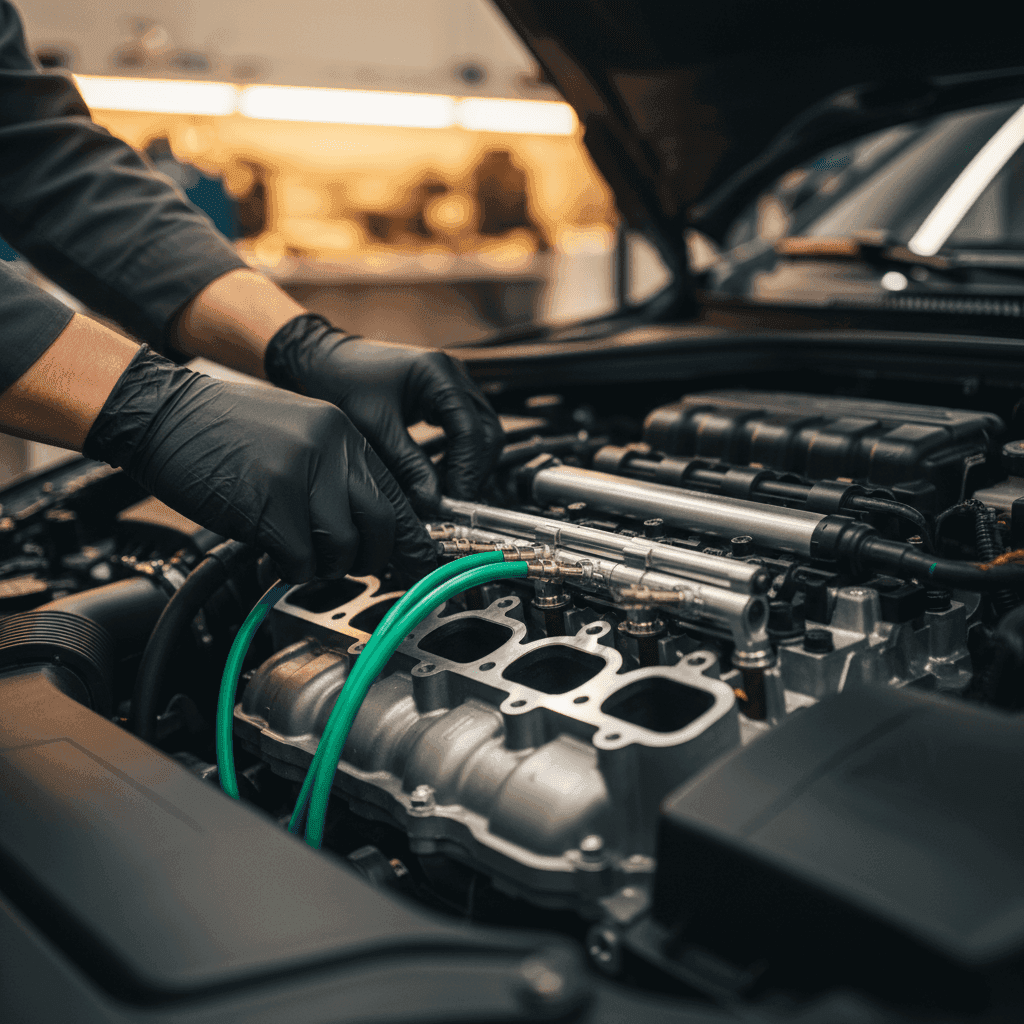
Since late February 2026, a litre of diesel in FBiH has jumped from around 2.53 KM to 3.68 KM, which is more than a full mark per litre in just over a month. At the same time, LPG in BiH is holding an average of 1.38 to 1.41 KM per litre, so suddenly every petrol or diesel driver is doing the maths on the back of a till receipt. In our Auto Gas Gaga workshop in Banja Luka, the number of installation enquiries has doubled since March, so here is an honest answer on how worthwhile the switch really is today.
Table of Contents
- What happened to fuel prices since February 2026
- Where LPG prices stand in BiH today
- How much you really save per kilometre and in KM
- What installation costs and when it pays back
- The mandatory five-year LPG inspection
- Which engines make sense for LPG conversion
- What AGG does on LPG systems in Banja Luka
- Frequently Asked Questions
- Related Articles
What happened to fuel prices since February 2026
Prices jumped fast and visibly. Between 28 February and 4 March 2026, the Federal Ministry of Trade received as many as 1,229 notifications of fuel price changes, 829 of them for diesel and 400 for 95-octane petrol. On 16 April 2026, the average price of 95 petrol in FBiH stood at 2.92 KM per litre, and diesel at 3.68 KM. In just over a month, a litre of diesel rose by 1.15 KM and petrol by 0.44 KM - the sharpest short-term jump we have seen in several years.
In RS, prices are slightly lower at some stations, but the gap is small and follows the same trend. The Goriva.ba aggregator currently records a diesel average of 3.29 KM per litre across roughly 505 stations around BiH, with petrol close to the federal average. For a driver covering 15,000 kilometres a year, that means this year's fuel bill is already running 800 to 1,200 KM higher than last year's, without a single extra kilometre on the odometer.
Where LPG prices stand in BiH today
While diesel and petrol keep climbing, LPG in BiH has been surprisingly stable. As of 21 April 2026, the average LPG price in BiH is 1.41 KM per litre according to nafta.hr, while the Goriva.ba aggregator across 505 stations records an average of 1.38 KM per litre. The difference between stations in Banja Luka tops out at five to seven feninga, and the reason is simple: distribution and market conditions for LPG work differently from those for refined products.
Put side by side, the LPG-to-diesel ratio is currently around 1 to 2.6. The LPG-to-95-petrol ratio is about 1 to 2.1. That does not automatically mean you drive at half the cost, because an engine running on LPG uses slightly more litres per hundred kilometres, but the gap is still huge. Even once you factor in higher gas consumption in litres, you end up with a real per-kilometre saving of around 40 to 55 percent compared with petrol, and even more against pricier diesel.
How much you really save per kilometre and in KM
Rather than working it out in our heads, let's use a realistic Banja Luka example. A typical family car, a 1.6 or 2.0 litre petrol, uses about 7 litres of 95 per hundred kilometres in mixed driving. On LPG it will use around 8.5 litres because LPG has a slightly lower calorific value. Over 100 kilometres, petrol costs you around 20.44 KM, while LPG costs around 11.90 KM. That is a saving of 8.54 KM every hundred kilometres.
If you cover 15,000 kilometres a year, the difference is around 1,280 KM annually compared with petrol alone. If you are coming off diesel and were planning to replace it with a petrol-LPG combination, the gap widens in LPG's favour, because at 3.68 KM per litre diesel costs you about 22 KM per hundred kilometres. Figures from independent analyses show that over an annual mileage of 15,000 km the diesel-versus-LPG comparison yields savings of around 1,700 KM a year, which matches what we see in the workshop.
What installation costs and when it pays back
A full LPG system installation in Banja Luka currently ranges from 1,000 to 1,500 KM, depending on the engine, the number of cylinders and the system you choose. Price varies with whether the engine is a four- or six-cylinder, whether it uses direct injection or classic MPI, and with the equipment maker - Lovato, STAG, BRC, Landi Renzo or Zavoli all sit in different price brackets. A quality tank, injector rail, reducer, ECU and certification are all included in that figure.
If you save around 1,280 KM a year against petrol, a 1,200 KM investment pays back in just under a year of driving. Coming off diesel, the payback is even faster because the saving runs over 1,700 KM a year. Every year after that is pure money back in your pocket. A more detailed calculation across several engine variants is in our guide Is an LPG conversion worth it in 2026?, where we broke the numbers down for three typical Banja Luka driver profiles.
The mandatory five-year LPG inspection
We need to be precise here because regulations differ between the entities. A mandatory LPG system certification in BiH is carried out every five years and costs around 300 KM. The inspection checks system tightness, the condition of the tank, the reducer and the piping, and the correct operation of the electronics. It is done at authorised facilities, and at AGG we walk clients through the whole process and hand the vehicle over with paperwork that will pass without delays.
In FBiH, registering a vehicle with an LPG system involves an additional annual fee, while RS has no such fee. For drivers in Banja Luka and the wider RS area, that means apart from the five-year certification there are no extra registration costs tied to the LPG system. If you often travel between the entities, it is worth knowing up front how that cost is calculated. Across the annual saving, even with the 300 KM certification spread over five years, the saving remains serious.
Which engines make sense for LPG conversion
LPG is ideal for naturally aspirated and turbocharged petrol engines with indirect fuel injection, which cover the vast majority of European used cars driving around Banja Luka today. Engines with direct injection - known as TSI, TFSI, GDI and similar designations - can run on LPG, but they require more advanced systems that protect the petrol injectors by feeding in a minimum amount of petrol and dose the gas accurately. For such engines we recommend proven systems like STAG DI or Landi Renzo MED, and an inspection before installation.
We do not convert diesel engines fully to LPG in passenger vehicles, because dual-fuel diesel systems are not cost-effective for a private driver on an annual mileage of 15,000 to 25,000 km. It is far more economical to sell the diesel and get a petrol-plus-LPG car, especially since used petrol prices in BiH remain stable while the diesel market - with its troublesome DPF filter and EGR valve - is getting more and more unpredictable. You can read more about that choice in our article on which vehicles are suitable for LPG conversion.
What AGG does on LPG systems in Banja Luka
Auto Gas Gaga does everything that falls under LPG, without exception. Full system installation, servicing of an existing system regardless of where it was fitted, injector cleaning and replacement, reducer inspection and replacement, leak testing with a detector, gas-phase filter replacement, map calibration on a diagnostic tool, the mandatory five-year inspection and preparation of paperwork for certification. We work on all the major systems - Lovato, STAG, BRC, Landi Renzo and Zavoli - and have been servicing them since 1996.
In practice that means a driver arriving with the fuel price jump as a motive gets a clear plan: a pre-installation vehicle check, a cost estimate in under half an hour, an installation slot within one to two weeks, and the vehicle goes straight into the registration paperwork afterwards. For cars already running on LPG that are performing poorly or consuming more than they should, we run diagnostics and decide what needs replacing versus what just needs cleaning. The goal is for LPG to be cheap and reliable, not just cheap.
Frequently Asked Questions
How much cheaper is LPG in BiH than petrol and diesel right now?
The LPG-to-diesel ratio in BiH in April 2026 is roughly 1 to 2.6, and the LPG-to-95-petrol ratio is about 1 to 2.1. In absolute terms that is a gap of around 1.50 KM per litre versus petrol and over 2.25 KM per litre versus diesel. Because LPG consumption is slightly higher in litres, the real per-kilometre saving is around 40 to 55 percent compared with petrol.
Does a 1,200 KM investment really pay back in a year?
For a driver covering 15,000 kilometres a year, yes. The annual saving against petrol is around 1,280 KM, and around 1,700 KM against diesel. If you drive less than 10,000 kilometres a year, payback stretches to about a year and a half to two years, so the numbers still work in your favour.
What is the mandatory LPG certification and how much does it cost?
It is a mandatory inspection of the LPG system in BiH, carried out every five years at an authorised facility. The current price is around 300 KM. The inspection checks system tightness, the condition of the tank and piping, and the operation of the reducer and electronics. Without a valid certificate the vehicle cannot pass its roadworthiness test.
Is LPG worth it if I drive a direct-injection TSI or TFSI?
Yes, but it requires a more advanced system that protects the petrol injectors. We recommend STAG DI or Landi Renzo MED, along with a mandatory engine inspection before installation. The saving is similar to classic engines, but the investment is slightly higher due to the extra electronics, so payback extends by a few months.
Does AGG service an LPG system installed by another workshop?
Yes. We take in vehicles with any system - Lovato, STAG, BRC, Landi Renzo, Zavoli - regardless of where the installation was done. We run diagnostics, clean injectors, replace filters and reducers, and carry out the five-year inspection. Before we start work we tell the client what really needs doing and what can wait.
Will LPG stay cheap in the years ahead?
Nobody can guarantee future prices, but the trend over the past 15 years shows LPG holding a stable gap against diesel and petrol. The gas market in Europe works differently from the refined-fuel market, and BiH has a developed network of over 500 stations. Even if the gap narrows a little, the installation investment already pays back in under a year.