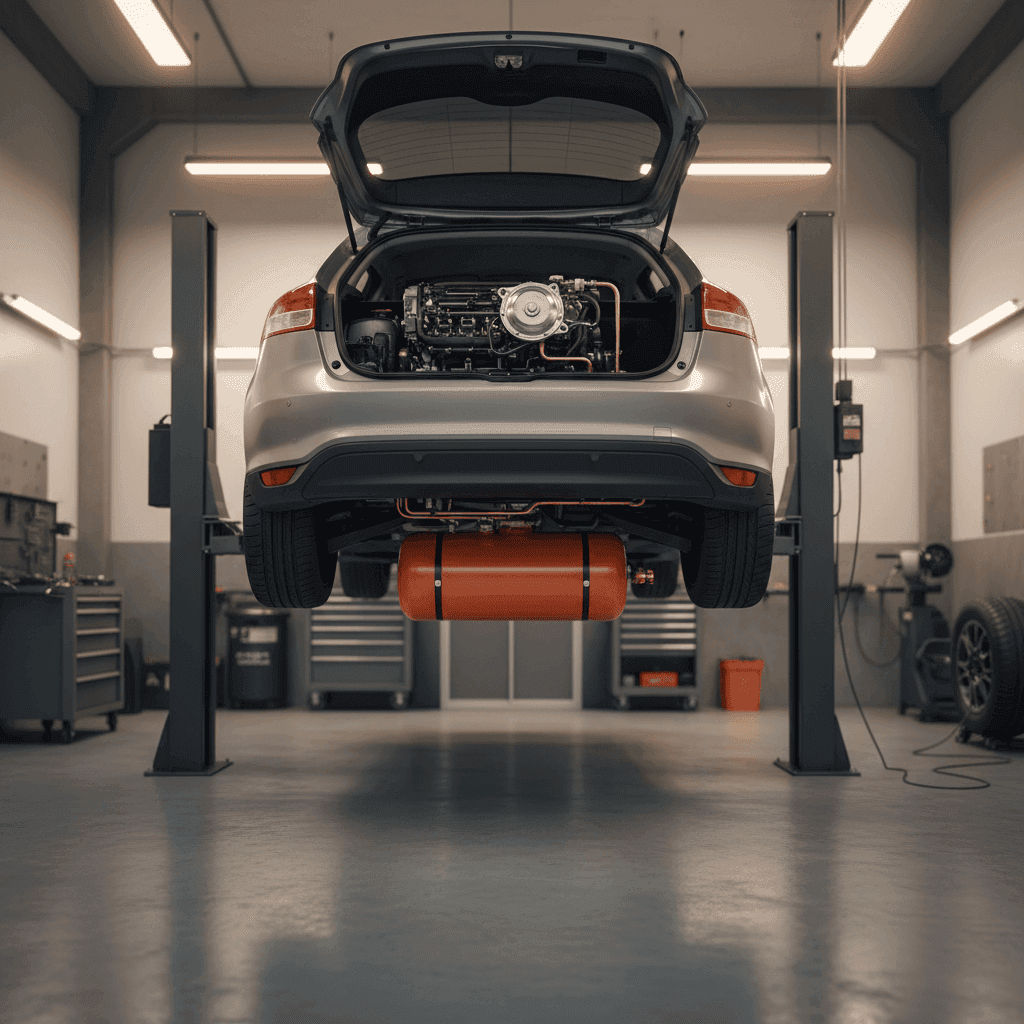
With LPG prices in BiH at around 1.41 KM per litre in April 2026 and diesel still holding above 2.50 KM, the per-kilometre gap has never been wider. The saving, however, is not only about the fuel price difference: LPG uses 10-15% more litres than petrol, and a certified installation requires a one-off 1,000-1,500 KM outlay. In this guide we calculate when an LPG conversion genuinely pays back for a Banja Luka driver, and on which engines it is worth starting the conversation at all.
Table of Contents
- Fuel Prices in BiH in April 2026
- How Much You Really Save per Kilometre Driven
- Return on Investment: When LPG Conversion Pays Off
- Real LPG Consumption Compared to Petrol and Diesel
- Hidden Costs: Certification, Service and Injector Cleaning
- Regulatory Differences: Republika Srpska vs Federation of BiH
- Which Engines LPG Pays Off On, and Which It Doesn't
- How to Spot a Quality Installation in Banja Luka
- Frequently Asked Questions
- Related Articles
Fuel Prices in BiH in April 2026
According to GlobalPetrolPrices for 13 April 2026, the average LPG price in BiH is 1.41 KM per litre, up 7.6% from a month earlier. The Goriva.ba portal, which tracks 1,025 filling stations across 132 BiH cities, shows a range of 1.15-1.64 KM per litre with an average of 1.38 KM in the same period. Figures move every week, so treat the numbers in this article as indicative and check the current situation on Goriva.ba before heading to the pump.
In March 2026 the average retail LPG price in BiH was 1.29 KM per litre, diesel 2.55 KM and petrol 2.37 KM. At that point LPG was almost half the price of petrol. By 20 April 2026 diesel had risen to 3.67 KM and petrol 95 to 2.94 KM (nafta.hr). The early-March rise was tied to increases in crude futures and tensions between Iran and the United States, with some RS-based stations raising prices by 5-10%.
LPG tracks crude oil with a smaller amplitude. When diesel and petrol go up 10%, LPG typically rises 4-6%. The gap between LPG and diesel in BiH is not linear, but over the past several years it has consistently stayed in favour of drivers running on gas.
How Much You Really Save per Kilometre Driven
The fairest way to check whether LPG pays off is per-kilometre maths, not per-litre. Here is how that looks for a typical family petrol car with 8 litres per 100 km consumption.
On petrol 95, at around 2.94 KM per litre, 100 km costs about 23.52 KM. On LPG, with a realistic 10-15% higher litre consumption, the same engine uses about 8.8-9.2 litres of gas per 100 km. At an LPG price of 1.41 KM, the cost for 100 km comes out at about 12.70 KM. The saving is therefore roughly 10.82 KM per 100 km compared with petrol 95.
We do not install LPG on diesel engines (dual-fuel diesel systems are rare, expensive and largely industrial), so the diesel comparison only matters when choosing between a diesel and an LPG-converted petrol car.
On an annual basis, for a driver covering 15,000 km, the April 2026 numbers work out to roughly 1,900 KM for LPG versus 3,530 KM for petrol in the same consumption class. The gap of about 1,630 KM a year goes directly toward paying back the conversion cost.
Return on Investment: When LPG Conversion Pays Off
A quality sequential LPG system in Banja Luka runs 1,000-1,500 KM, including the reducer, injectors, tank, lines, ECU and basic certification. The amount depends on the number of cylinders, tank size (37, 42 or 55 litres) and the manufacturer (Lovato, STAG, BRC, Landi Renzo, Zavoli).
The payback maths is simple: divide the installation cost by the annual saving. At 15,000 km a year and a saving of 1,630 KM against petrol, with an installation of 1,200 KM, payback lands at around nine months. At 10,000 km it shifts to roughly 13-14 months. At 20,000 km and above, payback is typically six to seven months.
The indicative break-even point starts at around 1,000 km per month. Below that, LPG is still the cheaper fuel, but payback only arrives after a year and a half to two years, which for an older vehicle can sit at the edge of rational. Above 15,000 km a year, LPG is almost always a clear win.
Real LPG Consumption Compared to Petrol and Diesel
An LPG-fuelled engine uses 10-15% more fuel in litres than petrol because of the lower energy value of gas per litre. The difference is physical, not software-driven, and cannot be erased by even the best tuning, only kept in check.
A properly tuned Golf 5 with a 1.6 petrol engine in mixed driving will burn about 7 litres of petrol or 7.7-8.1 litres of LPG per 100 km. If gas consumption climbs to 9-10 litres with no obvious reason, something is going on: the gas filter is clogged, the injectors are worn, the maps have drifted, or the lambda sensor is on its way out. Regular servicing is crucial here.
Diesel remains the most energy-efficient fuel. A modern 1.6 TDI easily cruises at 5-6 litres per 100 km. But with diesel at 3.67 KM per litre and LPG at 1.41 KM, a petrol car on LPG burning 9 litres costs about 12.70 KM per 100 km, while a diesel at 6 litres costs about 22.00 KM. The LPG advantage is clear even with somewhat higher litre consumption.
Hidden Costs: Certification, Service and Injector Cleaning
The LPG saving is real, but there are obligations that come with running an LPG vehicle and they belong in the annual cost calculation.
LPG system certification and re-certification. In BiH the re-certification is done every five years and covers the system certification (180 KM) and the tank certification (150 KM). If you replace the tank with a new one (around 250 KM), the new tank does not need a separate certification and the system certification is valid for seven years - you only pay 180 KM. Spread across the cycle, that is around 66 KM a year.
Regular LPG servicing. The interval is typically 10,000-15,000 km, or once a year. It covers the gas filter replacement, injector check, map calibration, and inspection of lines and the reducer. In Banja Luka the cost of LPG servicing sits within normal car maintenance and does not push the annual budget up significantly. The key is not to skip it: a neglected LPG system pushes consumption up directly and erodes the savings from switching.
Petrol injector cleaning. Engines that run constantly on LPG do not use the petrol injectors in full duty, so deposits build up inside them. Preventive cleaning every 60-80,000 km is a smart 80-150 KM investment.
Summed up, the annual fixed cost of running on LPG above the fuel itself lands at 150-200 KM. The saving against petrol of 1,630 KM a year far outweighs those fixed costs.
Regulatory Differences: Republika Srpska vs Federation of BiH
Regulations for LPG vehicles are not identical in the two BiH entities and this is something drivers often miss. In the Federation of BiH, LPG vehicle owners pay an annual road-use fee at registration that is about 20 KM higher than for conventional fuels. In Republika Srpska there is no such additional levy, which for drivers in Banja Luka practically means this line item does not exist.
A 20 KM difference is not decisive, but it is a sign that RS regulations do not penalise LPG further. LPG system certification is mandatory across all of BiH, as is registration of the conversion in the vehicle documents. More on the paperwork for LPG is available in our guide on LPG documentation and homologation in BiH.
Do not mix up the entity rules. If a colleague from Tuzla tells you they pay an annual LPG fee, it does not mean you will pay the same thing in Banja Luka, Prijedor or Doboj. Check the rule for your own entity at your technical inspection station.
Which Engines LPG Pays Off On, and Which It Doesn't
In our workshop we install LPG on virtually every petrol car that comes through the door, from 1996 onwards. Technically it is almost always doable, but "can be installed" and "worth installing" are not the same question.
Ideal candidates. Petrol engines with multi-point indirect injection (MPI), 1.4 to 2.5 litre displacement, covering more than 15,000 km a year. Golf 4 and 5 with the 1.6 petrol, Opel Astra H 1.6, Toyota Corolla 1.6, Hyundai i30 1.6, Peugeot 307 and 308, Renault Megane, Škoda Octavia 1.6. These engines handle LPG without issue, have durable valves and reasonable consumption. Their payback is typically 6-10 months.
Direct injection engines (TSI, TFSI, GDI). The story is more nuanced. Petrol normally cools the valves, and switching to LPG can accelerate valve wear, so the conversion requires a specific approach and an honest check of valve condition. If the vehicle has low mileage and you plan to run it for a long time, it is worth doing. If it has already rolled past 300,000 km, there are smarter places to spend your money.
Diesel engines. LPG is primarily for petrol engines. Dual-fuel systems for diesel exist, but they are rare, expensive and mainly used in commercial transport. For private vehicles in BiH this is not a route serious workshops recommend.
Small engines up to 1.0 and older carburettor cars. Technically possible, but the saving is minimal because they already burn little petrol. The investment there returns slowly.
How to Spot a Quality Installation in Banja Luka
A good LPG installation is recognisable before anyone looks under the bonnet. If a workshop agrees to install without inspecting the vehicle, that is the first warning sign. Fitting LPG onto an engine with worn spark plugs, poor compression or a lambda sensor fault only pushes the problem forward. A serious approach means an engine inspection, per-cylinder compression, spark plug and valve condition, and a diagnostic check before a single new part leaves the box.
From the shop, ask for a clear quote that includes every part (reducer, injectors, filter, tank with valves, lines, ECU), certification as a fixed line item, lead time, a warranty on labour and parts, and the option to service regularly with the same technician. If one shop installs and another services, every calibration becomes guesswork.
For Auto Gas Gaga in Banja Luka that means installing LPG since 1996, working on all five major sequential systems, a vehicle inspection as a mandatory step, and complete certification paperwork that ends with registration in the vehicle documents. Ask about experience on your specific engine - that is the best indicator.
Frequently Asked Questions
How quickly does an LPG conversion pay back in 2026?
For a driver covering 15,000 km a year who installs a system at around 1,200 KM, payback is roughly eight months compared with diesel and around nine months compared with petrol, at April 2026 fuel prices. At 20,000 km a year and above, payback is typically six months; below 10,000 km it shifts to a year and a half to two years.
Does LPG damage the engine?
On petrol engines with multi-point indirect injection, with regular servicing and a quality installation, LPG does not significantly shorten engine life. On direct injection engines (TSI, TFSI, GDI) a careful approach and an honest valve inspection are required. A neglected LPG system can push the engine into a lean mixture, which is a real hazard, so regular servicing is mandatory.
How much does LPG system re-certification cost in BiH?
System re-certification costs 180 KM, and tank re-certification 150 KM - a total of 330 KM every five years. If you replace the tank with a new one (around 250 KM), the new tank does not need a separate certification and the certification is valid for seven years - you only pay 180 KM. Amortised, that is around 66 KM a year.
Is there a special fee for LPG vehicles in Banja Luka?
No, Republika Srpska has no special annual fee for LPG vehicles at registration. That difference exists in the Federation of BiH, where the annual cost is about 20 KM higher than for conventional fuels.
Does LPG use more litres than petrol?
Yes, but the gap is smaller than many people think - around 10-15% more in litres compared with petrol. The difference is physical and cannot be eliminated, only kept in check. If consumption is noticeably higher than that, it is a signal the LPG service has not been done on time.
Is LPG conversion worth it on an older car with 300,000 km?
It depends. If it is an indirect injection engine in good compression health and you plan to drive it for another 50-80,000 km, it is worth doing. If the engine has problems the conversion will not fix, repair those first and only then talk about LPG.